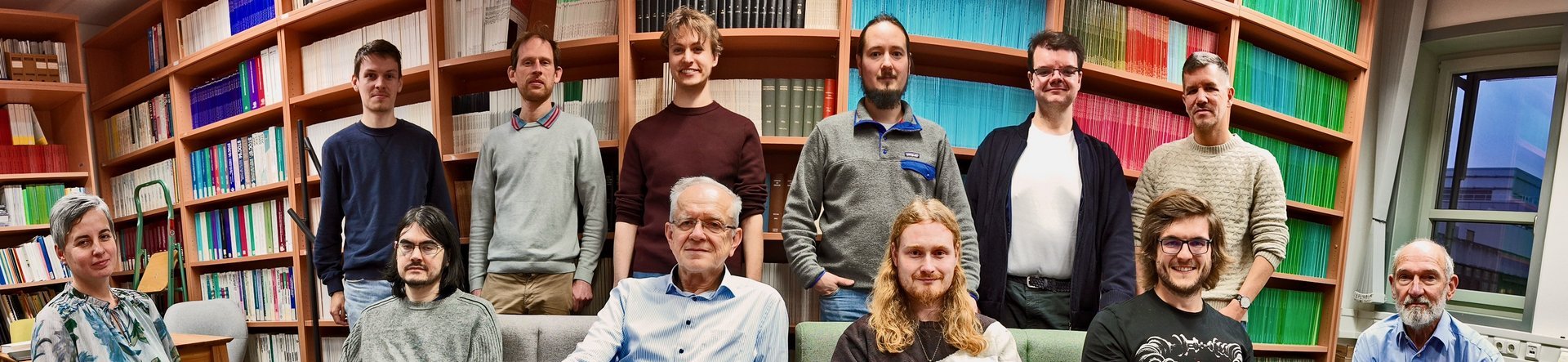
Prof. Dr. Maciej Liśkiewicz
Prof. Dr. Maciej Liskiewicz
Institutsprofessor
| E-mail: | maciej.liskiewcz@uni-luebeck.de |
| Adresse: | Institut für Thoeretische Informatik Ratzburger Allee 160 23562 Lübeck |
| Telefon: | +49 451 3101 5312 |
| Raum: | 14, 64 |

Lebenslauf
| 1976 | Abitur in Toruń, Polen |
| 1976 – 1981 | Studium an der Universität Wrocław |
| 1981 | Diplom in Informatik an der Universität Wrocław |
| 1981-1999 | Assistent und dann Adjunkt am Institut für Informatik, Universität Wrocław |
| 1990 | Promotion, Universität Wrocław |
| 1991-1993 | Post-Doc, Alexander von Humboldt-Stipendiat, TU Darmstadt (2 Jahre) |
| 1996 | Visiting Scientist Int. Computer Science Institute (ICSI), Berkeley (1 Jahr) |
| 1998 | Visiting Scientist, Eberhard-Karls-Universität Tübingen (1 Jahr) |
| 2000 | Habilitation, Universität Wrocław |
| 1999-2012 | Dozent, Universität zu Lübeck |
| 2012 – heute | apl. Professor der Universität zu Lübeck |
Preise und Stipendien
| 2026 | Top Area Chair at NeurIPS conference |
| 2022 | Top Reviewer at AISTATS: Conference on Artificial Intelligence and Statistics |
| 2021 | AAAI Distinguished Paper Award for our paper "Polynomial-Time Algorithms for Counting and Sampling Markov Equivalent DAGs" at AAAI Conference on Artificial Intelligence |
| 2021 | Best Student Paper Award for our paper (first author: Marcel Wienöbst) "Extendability of Causal Graphical Models: Algorithms and Computational Complexity" at Conference on Uncertainty in Artificial Intelligence (UAI) |
| 2014 | IBM Best Student Paper Award for our paper (first author: Benito van der Zander) "Constructing Separators and Adjustment Sets in Ancestral Graphs" at Conference on Uncertainty in Artificial Intelligence (UAI) |
| 2010 | Nominated for best paper award at GECCO conference 2010 for our paper "Negative selection algorithms without generating detectors" |
| 1991-1992 | Alexander von Humboldt-Stipendium |
2021
M.
Wienöbst
M.
Bannach
M.
Liskiewicz, 2021, S. 1248-1257
Extendability of causal graphical models: Algorithms and computational complexity.
Extendability of causal graphical models: Algorithms and computational complexity.
@conference{c674e0abf588432890609e58d391a161,title = "Extendability of causal graphical models: Algorithms and computational complexity.",author = "Marcel Wien{\"o}bst and Max Bannach and Maciej Liskiewicz",note = "DBLP's bibliographic metadata records provided through http://dblp.org/search/publ/api are distributed under a Creative Commons CC0 1.0 Universal Public Domain Dedication. Although the bibliographic metadata records are provided consistent with CC0 1.0 Dedication, the content described by the metadata records is not. Content may be subject to copyright, rights of privacy, rights of publicity and other restrictions.",year = "2021",language = "English",pages = "1248--1257",}
M.
Wienöbst
M.
Bannach
M.
Liskiewicz, 2021, S. 12198-12206
Polynomial-Time Algorithms for Counting and Sampling Markov Equivalent DAGs.
Polynomial-Time Algorithms for Counting and Sampling Markov Equivalent DAGs.
@conference{c0e0e31e0eb2483ab48dfb2d0eb5b4f1,title = "Polynomial-Time Algorithms for Counting and Sampling Markov Equivalent DAGs.",author = "Marcel Wien{\"o}bst and Max Bannach and Maciej Liskiewicz",note = "DBLP's bibliographic metadata records provided through http://dblp.org/search/publ/api are distributed under a Creative Commons CC0 1.0 Universal Public Domain Dedication. Although the bibliographic metadata records are provided consistent with CC0 1.0 Dedication, the content described by the metadata records is not. Content may be subject to copyright, rights of privacy, rights of publicity and other restrictions.",year = "2021",doi = "10.1609/AAAI.V35I13.17448",language = "English",pages = "12198--12206",}
2020
O.
Seker
T.
Eisenbarth
M.
Liskiewicz, 2020. 48 S.
A White-Box Masking Scheme Resisting Computational and Algebraic Attacks
A White-Box Masking Scheme Resisting Computational and Algebraic Attacks
@misc{154907e9b53e4460b67a5343ea5d0246,title = "A White-Box Masking Scheme Resisting Computational and Algebraic Attacks",abstract = "Abstract: White-box cryptography attempts to protect cryptographic secrets in pure software implementations. Due to their high utility, white-box cryptosystems (WBC) are deployed by the industry even though the security of these constructions is not well defined. A major breakthrough in generic cryptanalysis of WBC was Differential Computation Analysis (DCA), which requires minimal knowledge of the underlying white-box protection and also thwarts many obfuscation methods. To avert DCA, classic masking countermeasures originally intended to protect against highly related side-channel attacks have been proposed for use in WBC. However, due to the controlled environment of WBCs, new algebraic attacks against classic masking schemes have quickly been found. These algebraic DCA attacks break all classic masking countermeasures efficiently, as they are independent of the masking order. In this work, we propose a novel generic masking scheme that can resist both DCA and algebraic DCA attacks. The proposed scheme extends the seminal work by Ishai et al. which is probing secure and thus resists DCA, to also resist algebraic attacks. To prove the security of our scheme, we demonstrate the connection between two main security notions in white-box cryptography: probing security and prediction security. Resistance of our masking scheme to DCA is proven for an arbitrary order of protection, using the well-known strong non-interference notion by Barthe et al. Our masking scheme also resists algebraic attacks, which we show concretely for first and second order algebraic protection. Moreover, we present an extensive performance analysis and quantify the overhead of our scheme, for a proof-of-concept protection of an AES implementation. ",author = "Okan Seker and Thomas Eisenbarth and Maciej Liskiewicz",note = "https://eprint.iacr.org/2020/443",year = "2020",month = oct,day = "20",language = "English",type = "Other",}
S.
Berndt
M.
Liśkiewicz, 2020
On the universal steganography of optimal rate
On the universal steganography of optimal rate
@article{af277bb9b53c4b7aa69a6a3dec916a18,title = "On the universal steganography of optimal rate",abstract = "In this work, we present the first secure stegosystem in the common computational model which, for any communication channel, is provably secure, reliable, and has nearly optimal bandwidth, but needs super-polynomial time. This solves several open problems about secret-key steganography in the computational model. In particular, our result answers affirmatively the question whether there exists a secure and reliable universal system of rate asymptotically larger than logκ, where κ is the security parameter. Next, we prove a lower bound on the query complexity of stegosystems showing that our construction is optimal. This lower bound extends the results by Hopper et al. (2009) [19] and by Dedi{\'c} et al. (2009) [22]. We also discuss universal steganography of optimal rate in the information-theoretic setting. We prove that an exponential number of samples is needed to embed messages in documents of high min-entropy. Our results, together with the result by Cachin (2004) [16], show that the situation of universal steganography in the computational and in the information-theoretic model is analogous: optimal universal steganography exists, but the protocols need super-polynomial time.",author = "Sebastian Berndt and Maciej Li{\'s}kiewicz",note = "Publisher Copyright: {\textcopyright} 2020 Elsevier Inc. Copyright: Copyright 2020 Elsevier B.V., All rights reserved.",year = "2020",month = dec,doi = "10.1016/j.ic.2020.104632",language = "English",volume = "275",journal = "Information and Computation",issn = "0890-5401",publisher = "Elsevier Inc.",}
M.
Wienöbst
M.
Liskiewicz, 2020, S. 10302-10309. 8 S.
Recovering Causal Structures from Low-Order Conditional Independencies , The Thirty-Fourth AAAI Conference on Artificial Intelligence
Recovering Causal Structures from Low-Order Conditional Independencies , The Thirty-Fourth AAAI Conference on Artificial Intelligence
@conference{66bb9388424c495980aca133c2b86eca,title = "Recovering Causal Structures from Low-Order Conditional Independencies",abstract = "One of the common obstacles for learning causal models from data is that high-order conditional independence (CI) relationships between random variables are difficult to estimate. Since CI tests with conditioning sets of low order can be performed accurately even for a small number of observations, a reasonable approach to determine casual structures is to base merely on the low-order CIs. Recent research has confirmed that, e.g. in the case of sparse true causal models, structures learned even from zero- and first-order conditional independencies yield good approximations of the models. However, a challenging task here is to provide methods that faithfully explain a given set of low-order CIs. In this paper, we propose an algorithm which, for a given set of conditional independencies of order less or equal to k, where k is a small fixed number, computes a faithful graphical representation of the given set. Our results complete and generalize the previous work on learning from pairwise marginal independencies. Moreover, they enable to improve upon the 0-1 graph model which, e.g. is heavily used in the estimation of genome networks. ",author = "Marcel Wien{\"o}bst and Maciej Liskiewicz",year = "2020",month = apr,day = "3",doi = "10.1609/aaai.v34i06.6593",language = "English",pages = "10302--10309",note = "The Thirty-Fourth AAAI Conference on Artificial Intelligence , AAAI-20 ; Conference date: 07-02-2020 Through 12-02-2020",}
C.
Rosenke
M.
Liśkiewicz, 2020
The generic combinatorial algorithm for image matching with classes of projective transformations
The generic combinatorial algorithm for image matching with classes of projective transformations
@article{598f506d8b15427f80206e386f32211e,title = "The generic combinatorial algorithm for image matching with classes of projective transformations",abstract = "Image matching is an important task arising in video compression, optical character recognition, medical imaging, watermarking and in many others fields. Given two digital images A and B, image matching determines a transformation f for A such that it most closely resembles B. In this paper, we introduce the first general discretization technique that works for the class of projective transformations as well as plenty of its subclasses such as affine transformations and several combinations of scaling, rotation and translation. Based on this, we provide a fully generic image matching algorithm for all these classes that runs in polynomial time.",author = "Christian Rosenke and Maciej Li{\'s}kiewicz",note = "Publisher Copyright: {\textcopyright} 2020 Elsevier Inc. Copyright: Copyright 2020 Elsevier B.V., All rights reserved.",year = "2020",month = dec,doi = "10.1016/j.ic.2020.104550",language = "English",volume = "275",journal = "Information and Computation",issn = "0890-5401",publisher = "Elsevier Inc.",}
2019
B.
van der Zander
M.
Liskiewicz, 2019, S. 637-647. 11 S.
Finding minimal d-separators in linear time and applications , 35th Conference on Uncertainty in Artificial Intelligence
Finding minimal d-separators in linear time and applications , 35th Conference on Uncertainty in Artificial Intelligence
@conference{ae2c294a2b0d461ba389745966efbe2d,title = "Finding minimal d-separators in linear time and applications",abstract = "The study of graphical causal models is fundamentally the study of separations and conditional independences. We provide linear-time algorithms for two graphical primitives: to test, if a given set is a minimal d-separator, and to find a minimal d-separator in directed acyclic graphs (DAGs), completed partially directed acyclic graphs (CPDAGs) and restricted chain graphs (RCGs) as well as minimal m-separators in ancestral graphs (AGs). These algorithms improve the runtime of the best previously known algorithms for minimal separators that are based on moralization and thus require quadratic time to construct and handle the moral graph. (Minimal) separating sets have important applications like finding (minimal) covariate adjustment sets or conditional instrumental variables.",author = "\{van der Zander\}, Benito and Maciej Liskiewicz",note = "Funding Information: ∗ This work was supported by the Deutsche Forschungs-gemeinschaft (DFG) grant LI 634/4-2. Publisher Copyright: {\textcopyright} 2019 Association For Uncertainty in Artificial Intelligence (AUAI). All rights reserved. Copyright: Copyright 2020 Elsevier B.V., All rights reserved.; 35th Conference on Uncertainty in Artificial Intelligence , UAI 2019 ; Conference date: 22-07-2019 Through 25-07-2019",year = "2019",language = "English",pages = "637--647",}
Weitere Links:
B.
van der Zander
J.
Textor
M.
Liskiewicz, 2019, S. 135-138. 4 S.
Graphical methods for finding instrumental variables , 17th Cologne-Twente Workshop on Graphs and Combinatorial Optimization <br/>
Graphical methods for finding instrumental variables , 17th Cologne-Twente Workshop on Graphs and Combinatorial Optimization <br/>
@conference{b1e12f6b1acb4160ada81587c89c5b8b,title = "Graphical methods for finding instrumental variables",abstract = "Instrumental variables (IVs) are a popular approach to identify causal effects. For valid inference, IVs must not be direct causes of any variable in the model except the explanatory variable X. Such variables do not exist in many model instances, so the approach has been generalized to conditional IVs. However, a barrier for application of this method is of algorithmic nature: So far, it was not clear whether such conditional IVs can be tested and found efficiently. We prove that it is indeed an NPcomplete problem to test if a given variable is a conditional IV. However, if the covariates are restricted to ancestors, this test can be performed in linear time. This implies a new definition of IVs, which we term ancestral IVs. It turns out that an ancestral IV exists if and only if a conditional IV exists in a graph. We use this definition to obtain efficient algorithms to find conditional IVs.",author = "\{van der Zander\}, Benito and Johannes Textor and MacIej Liskiewicz",note = "Funding Information: Acknowledgment. This work was supported by the Deutsche Forschungsgemeinschaft (DFG) grant LI 634/4-2. Publisher Copyright: {\textcopyright} Proceedings of the 17th Cologne-Twente Workshop on Graphs and Combinatorial Optimization, CTW 2019. Copyright: Copyright 2021 Elsevier B.V., All rights reserved.; 17th Cologne-Twente Workshop on Graphs and Combinatorial Optimization <br/>, CTW 2019 ; Conference date: 01-07-2019 Through 03-07-2019",year = "2019",language = "English",pages = "135--138",}
Weitere Links:
2018
S.
Berndt
M.
Liskiewicz, 2018, S. 29-60. 32 S.
On the Gold Standard for Security of Universal Steganography , 37th Annual International Conference on the Theory and Applications of Cryptographic Techniques
On the Gold Standard for Security of Universal Steganography , 37th Annual International Conference on the Theory and Applications of Cryptographic Techniques
@inproceedings{9954cb064c664821a6bf0399eec1882d,title = "On the Gold Standard for Security of Universal Steganography",abstract = "While symmetric-key steganography is quite well understood both in the information-theoretic and in the computational setting, many fundamental questions about its public-key counterpart resist persistent attempts to solve them. The computational model for public-key steganography was proposed by von Ahn and Hopper in EUROCRYPT 2004. At TCC 2005, Backes and Cachin gave the first universal public-key stegosystem {\textendash} i.e. one that works on all channels {\textendash} achieving security against replayable chosen-covertext attacks (ss-rcca) and asked whether security against non-replayable chosen-covertext attacks (ss-cca) is achievable. Later, Hopper (ICALP 2005) provided such a stegosystem for every efficiently sampleable channel, but did not achieve universality. He posed the question whether universality and ss-cca-security can be achieved simultaneously. No progress on this question has been achieved since more than a decade. In our work we solve Hopper{\textquoteright}s problem in a somehow complete manner: As our main positive result we design an ss-cca-secure stegosystem that works for every memoryless channel. On the other hand, we prove that this result is the best possible in the context of universal steganography. We provide a family of 0-memoryless channels {\textendash} where the already sent documents have only marginal influence on the current distribution {\textendash} and prove that no ss-cca-secure steganography for this family exists in the standard non-look-ahead model.",author = "Sebastian Berndt and Maciej Liskiewicz",year = "2018",doi = "10.1007/978-3-319-78381-9\_2",language = "English",isbn = "978-3-319-78380-2",volume = "10820 LNCS",series = "Lecture Notes in Computer Science",publisher = "Springer Berlin Heidelberg",pages = "29--60",editor = "\{Buus Nielsen\}, \{Jesper \} and Rijmen, \{Vincent \}",booktitle = "EUROCRYPT 2018: Advances in Cryptology {\textendash} EUROCRYPT 2018",note = "37th Annual International Conference on the Theory and Applications of Cryptographic Techniques , EUROCRYPT 2018 ; Conference date: 29-04-2018 Through 03-05-2018",}
B.
van der Zander
M.
Liskiewicz
J.
Textor, 2018. 52 S.
Separators and adjustment sets in causal graphs: Complete criteria and an algorithmic framework.
Separators and adjustment sets in causal graphs: Complete criteria and an algorithmic framework.
@misc{27d7c3a405d44e93a6d5b5a4807c3462,title = "Separators and adjustment sets in causal graphs: Complete criteria and an algorithmic framework.",abstract = "Principled reasoning about the identifiability of causal effects from non-experimental data is an important application of graphical causal models. This paper focuses on effects that are identifiable by covariate adjustment, a commonly used estimation approach. We present an algorithmic framework for efficiently testing, constructing, and enumerating m-separators in ancestral graphs (AGs), a class of graphical causal models that can represent uncertainty about the presence of latent confounders. Furthermore, we prove a reduction from causal effect identification by covariate adjustment to m-separation in a subgraph for directed acyclic graphs (DAGs) and maximal ancestral graphs (MAGs). Jointly, these results yield constructive criteria that characterize all adjustment sets as well as all minimal and minimum adjustment sets for identification of a desired causal effect with multiple exposures and outcomes in the presence of latent confounding. Our results extend several existing solutions for special cases of these problems. Our efficient algorithms allowed us to empirically quantify the identifiability gap between covariate adjustment and the do-calculus in random DAGs and MAGs, covering a wide range of scenarios. Implementations of our algorithms are provided in the R package DAGITTY.",author = "\{van der Zander\}, Benito and Maciej Liskiewicz and Johannes Textor",year = "2018",language = "English",type = "Other",}