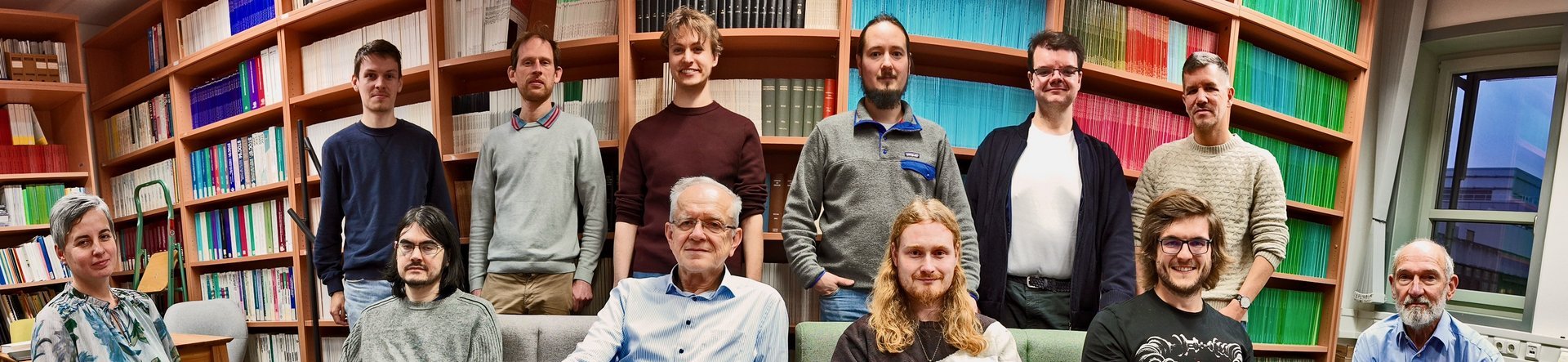
Prof. Dr. Rüdiger Reischuk
Prof. Dr. math. Rüdiger Reischuk
emeritus Institutsprofessor
| E-mail: | ruediger.reischuk@uni-luebeck.de |
| Adresse: | Institut für Theoretische Informatik Ratzeburger Allee 160 23562 Lübeck |
| Telefon: | +49 451 3101 5310 |
| Raum: | Raum 2083, Gebäude 64 |

Lebenslauf
| 1975 | geboren in Berlin |
| 1984 – 1990 | Jugendzeit in Windhuk, Namibia |
| 1994 | Abitur in Berlin |
| 1994 – 1999 | Studium an der TU Berlin |
| 1995 | Grundwehrdienst |
| 1999 | Diplom in Informatik an der TU Berlin |
| 1999 – 2005 | Wissenschaftlicher Mitarbeiter am Lehrstuhl Prof. Siefkes, TU Berlin |
| 2001 | Diplom in Mathematik an der TU Berlin |
| 2003 | Promotion zum Dr. rer.-nat. an der TU Berlin |
| 2004 | Einjähriger Forschungsaufenthalt bei Richard Karp am ICSI, Berkeley |
| 2005 | Ernennung zum Universitätsprofessor für Theoretische Informatik an der Universität zu Lübeck (W2) |
| 2007 | Verpartnerung mit Carsten Lenz |
| 2008 – 2025 | Studiendekan der Technisch-Naturwissenschaftlichen Fakultät, später der MINT-Sektionen |
| 2014 – 2020 | Vorsitzender des Wissenschaftlichen Beirats des Bundeswettbewerbs Informatik |
| 2015 | Ernennung zum W3-Professor an der Universität zu Lübeck |
| 2023 – heute | Vizepräsident der Universität zu Lübeck |
Positionen und Ämter
Preise und Stipendien
| 1993 | Silbermedaille bei der Internationalen Olympiade der Informatik in Mendoza, Argentinien |
| 1993 | Studienstipendium durch die Studienstiftung des Deutschen Volkes |
| 1994 | Dr. Habbena Preis für ein sehr gutes Abitur |
| 1999 | Erwin-Stephan-Preis der TU Berlin |
| 2002 | Best student paper award bei der MFCS 2002 |
| 2003 | Doktorarbeit wird für den GI-Dissertationspreis vorgeschlagen |
| 2007, 2010, 2014, 2018, 2021 | Lehrpreise der Studierenden der technisch-naturwissenschaftlichen Fakultät / der MINT-Sektionen (Heliprof 2007, Heliprof 2010, Heliprof 2014, Heliprof 2018, Heliprof 2021) |
2026
F.
Chudigiewitsch
T.
Tantau
F.
Winkler, 2026
On the Complexity of Fundamental Problems for DAG-Compressed Graphs
On the Complexity of Fundamental Problems for DAG-Compressed Graphs
@misc{bc9e4e00aabf4cada7c71f1d516a6e6d,title = "On the Complexity of Fundamental Problems for DAG-Compressed Graphs",author = "Florian Chudigiewitsch and Till Tantau and Felix Winkler",year = "2026",doi = "10.48550/ARXIV.2603.22063",language = "English",publisher = "arXiv",type = "Other",}
F.
Chudigiewitsch
M.
Gründel
C.
Komusiewicz
N.
Morawietz
T.
Tantau, 2026, S. 93:1-93:17
The Descriptive Complexity of Relation Modification Problems , 51st International Symposium on Mathematical Foundations of Computer Science
The Descriptive Complexity of Relation Modification Problems , 51st International Symposium on Mathematical Foundations of Computer Science
@conference{a0387b904b774a94a781e17f87f4b5e5,title = "The Descriptive Complexity of Relation Modification Problems",author = "Florian Chudigiewitsch and Marlene Gr{\"u}ndel and Christian Komusiewicz and Nils Morawietz and Till Tantau",year = "2026",doi = "10.4230/LIPICS.MFCS.2026.93",language = "English",pages = "93:1--93:17",note = "51st International Symposium on Mathematical Foundations of Computer Science, MFCS ; Conference date: 24-08-2026 Through 28-08-2026",}
F.
Chudigiewitsch
M.
Gründel
C.
Komusiewicz
N.
Morawietz
T.
Tantau, 2026
The Descriptive Complexity of Relation Modification Problems
The Descriptive Complexity of Relation Modification Problems
@misc{6c20df9147bb4f0284c7b29cb65f6ec0,title = "The Descriptive Complexity of Relation Modification Problems",author = "Florian Chudigiewitsch and Marlene Gr{\"u}ndel and Christian Komusiewicz and Nils Morawietz and Till Tantau",year = "2026",doi = "10.48550/ARXIV.2603.22043",language = "English",publisher = "arXiv",type = "Other",}
2024
M.
Bannach
F.
Chudigiewitsch
T.
Tantau, 2024, S. 17:1-17:14
On the Descriptive Complexity of Vertex Deletion Problems.
On the Descriptive Complexity of Vertex Deletion Problems.
@conference{157314b80d9e41e39d1df9f525450256,title = "On the Descriptive Complexity of Vertex Deletion Problems.",author = "Max Bannach and Florian Chudigiewitsch and Till Tantau",note = "DBLP's bibliographic metadata records provided through http://dblp.org/search/publ/api are distributed under a Creative Commons CC0 1.0 Universal Public Domain Dedication. Although the bibliographic metadata records are provided consistent with CC0 1.0 Dedication, the content described by the metadata records is not. Content may be subject to copyright, rights of privacy, rights of publicity and other restrictions.",year = "2024",doi = "10.4230/LIPICS.MFCS.2024.17",language = "English",pages = "17:1--17:14",}
M.
Bannach
F.
Chudigiewitsch
T.
Tantau, 2024
On the Descriptive Complexity of Vertex Deletion Problems.
On the Descriptive Complexity of Vertex Deletion Problems.
@misc{0cabb4dd800c4aec8805163715661013,title = "On the Descriptive Complexity of Vertex Deletion Problems.",author = "Max Bannach and Florian Chudigiewitsch and Till Tantau",note = "DBLP's bibliographic metadata records provided through http://dblp.org/search/publ/api are distributed under a Creative Commons CC0 1.0 Universal Public Domain Dedication. Although the bibliographic metadata records are provided consistent with CC0 1.0 Dedication, the content described by the metadata records is not. Content may be subject to copyright, rights of privacy, rights of publicity and other restrictions.",year = "2024",doi = "10.48550/ARXIV.2406.18299",language = "English",volume = "abs/2406.18299",type = "Other",}
2023
M.
Bannach
F.
Chudigiewitsch
T.
Tantau, 2023
Existential Second-Order Logic Over Graphs
Existential Second-Order Logic Over Graphs
@techreport{3898d5bccc6b410c8a2019a927868aa4,title = "Existential Second-Order Logic Over Graphs: Parameterized Complexity",abstract = "By Fagin's Theorem, NP contains precisely those problems that can be described by formulas starting with an existential second-order quantifier, followed by only first-order quantifiers (ESO formulas). Subsequent research refined this result, culminating in powerful theorems that characterize for each possible sequence of first-order quantifiers how difficult the described problem can be. We transfer this line of inquiry to the parameterized setting, where the size of the set quantified by the second-order quantifier is the parameter. Many natural parameterized problems can be described in this way using simple sequences of first-order quantifiers: For the clique or vertex cover problems, two universal first-order quantifiers suffice ({"}for all pairs of vertices ... must hold{"}); for the dominating set problem, a universal followed by an existential quantifier suffice ({"}for all vertices, there is a vertex such that ...{"}); and so on. We present a complete characterization that states for each possible sequence of first-order quantifiers how high the parameterized complexity of the described problems can be. The uncovered dividing line between quantifier sequences that lead to tractable versus intractable problems is distinct from that known from the classical setting, and it depends on whether the parameter is a lower bound on, an upper bound on, or equal to the size of the quantified set.",author = "Max Bannach and Florian Chudigiewitsch and Till Tantau",year = "2023",month = oct,day = "2",language = "English",type = "WorkingPaper",}
M.
Bannach
F.
Chudigiewitsch
T.
Tantau, 2023, S. 3:1-3:15
Existential Second-Order Logic over Graphs: Parameterized Complexity.
Existential Second-Order Logic over Graphs: Parameterized Complexity.
@conference{f5f69a40fe8d4bd6b4ba611b4f3262ad,title = "Existential Second-Order Logic over Graphs: Parameterized Complexity.",author = "Max Bannach and Florian Chudigiewitsch and Till Tantau",note = "DBLP's bibliographic metadata records provided through http://dblp.org/search/publ/api are distributed under a Creative Commons CC0 1.0 Universal Public Domain Dedication. Although the bibliographic metadata records are provided consistent with CC0 1.0 Dedication, the content described by the metadata records is not. Content may be subject to copyright, rights of privacy, rights of publicity and other restrictions.",year = "2023",doi = "10.4230/LIPICS.IPEC.2023.3",language = "English",pages = "3:1--3:15",}
M.
Bannach
F.
Chudigiewitsch
T.
Tantau, 2023
Existential Second-Order Logic Over Graphs: Parameterized Complexity.
Existential Second-Order Logic Over Graphs: Parameterized Complexity.
@misc{87bcd7890c094181ab5ddeceda38c390,title = "Existential Second-Order Logic Over Graphs: Parameterized Complexity.",author = "Max Bannach and Florian Chudigiewitsch and Till Tantau",note = "DBLP's bibliographic metadata records provided through http://dblp.org/search/publ/api are distributed under a Creative Commons CC0 1.0 Universal Public Domain Dedication. Although the bibliographic metadata records are provided consistent with CC0 1.0 Dedication, the content described by the metadata records is not. Content may be subject to copyright, rights of privacy, rights of publicity and other restrictions.",year = "2023",doi = "10.48550/ARXIV.2310.01134",language = "English",volume = "abs/2310.01134",type = "Other",}
2021
M.
Bannach
T.
Tantau, 2021
On the descriptive complexity of color coding
On the descriptive complexity of color coding
@article{711825580a5d416180e63facc7365b84,title = "On the descriptive complexity of color coding",abstract = "Color coding is an algorithmic technique used in parameterized complexity theory to detect {\textquotedblleft}small{\textquotedblright} structures inside graphs. The idea is to derandomize algorithms that first randomly color a graph and then search for an easily-detectable, small color pattern. We transfer color coding to the world of descriptive complexity theory by characterizing{\textemdash}purely in terms of the syntactic structure of describing formulas{\textemdash}when the powerful second-order quantifiers representing a random coloring can be replaced by equivalent, simple first-order formulas. Building on this result, we identify syntactic properties of first-order quantifiers that can be eliminated from formulas describing parameterized problems. The result applies to many packing and embedding problems, but also to the long path problem. Together with a new result on the parameterized complexity of formula families involving only a fixed number of variables, we get that many problems lie in FPT just because of the way they are commonly described using logical formulas.",author = "Max Bannach and Till Tantau",note = "Publisher Copyright: {\textcopyright} MDPI AG. All rights reserved.",year = "2021",month = mar,doi = "10.3390/a14030096",language = "English",volume = "14",journal = "Algorithms",issn = "1999-4893",publisher = "Multidisciplinary Digital Publishing Institute (MDPI)",number = "3",}
2020
M.
Bannach
T.
Tantau, 2020, S. 374-399
Computing Hitting Set Kernels By AC0-Circuits.
Computing Hitting Set Kernels By AC0-Circuits.
@article{3bc08942174049b4b7b8d0c9772cded3,title = "Computing Hitting Set Kernels By AC0-Circuits.",abstract = "Given a hypergraphH= (V,E), what is the smallest subsetX⊆Vsuch thate∩X6=∅holds for alle∈E? This problem, known as thehitting set problem,is a basic problem inparameterized complexity theory. There are well-known kernelization algorithms for it, whichget a hypergraphHand a numberkas input and output a hypergraphH′such that (1)Hhasa hitting set of sizekif, and only if,H′has such a hitting set and (2) the size ofH′dependsonly onkand on the maximum cardinalitydof edges inH. The algorithms run in polynomialtime, but are highly sequential. Recently, it has been shown that one of them can be parallelizedto a certain degree: one can compute hitting set kernels in parallel timeO(d){\textendash} but it wasconjectured that this is the best parallel algorithm possible. We refute this conjecture and showhow hitting set kernels can be computed inconstantparallel time. For our proof, we introducea new, generalized notion of hypergraph sunflowers and show how iterated applications of thecolor coding technique can sometimes be collapsed into a single application. 2012 ACM Subject Classification: Mathematics of computing→Hypergraphs, Theory of computation→Fixed parameter tractability, Theory of computation→Circuit complexity Keywords and phrases: Parallel Computation, Fixed-parameter Tractability, Kernelization Digital Object Identifier (DOI): 10.4230/LIPIcs.STACS.2018.9 Related Version: Full proofs can be found in the full version of the paper [5],http://arxiv.org/abs/1801.00716.",author = "Max Bannach and Till Tantau",note = "DBLP's bibliographic metadata records provided through http://dblp.org/search/publ/api are distributed under a Creative Commons CC0 1.0 Universal Public Domain Dedication. Although the bibliographic metadata records are provided consistent with CC0 1.0 Dedication, the content described by the metadata records is not. Content may be subject to copyright, rights of privacy, rights of publicity and other restrictions.",year = "2020",doi = "10.1007/S00224-019-09941-Z",language = "English",volume = "64",pages = "374--399",journal = "Theory Comput. Syst.",number = "3",}