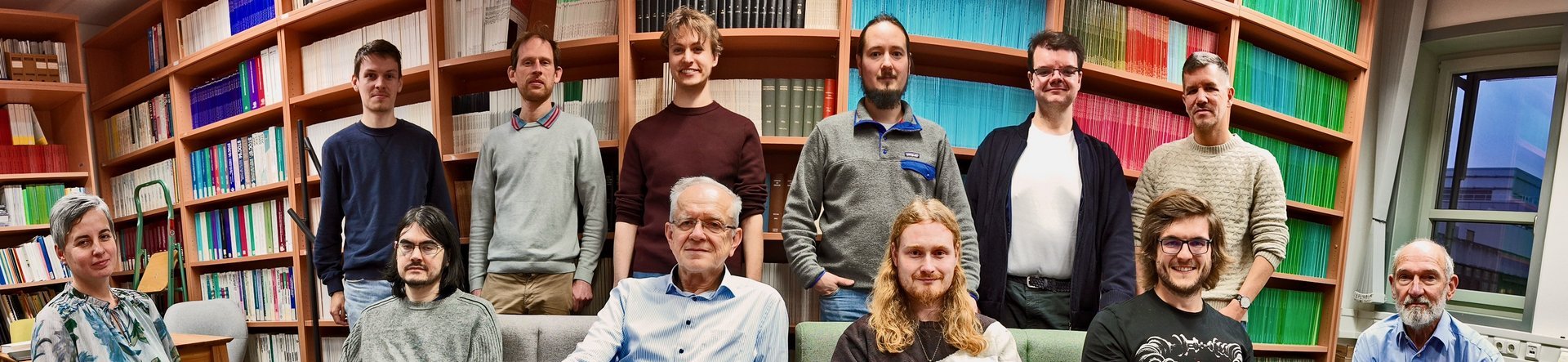
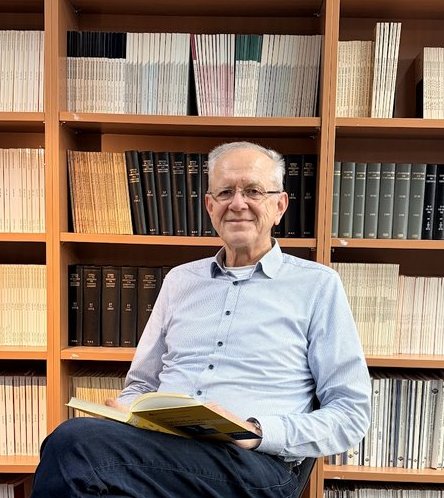
Prof. Dr. Maciej Liśkiewicz
Prof. Dr. Maciej Liskiewicz
Institutsprofessor
| E-mail: | maciej.liskiewcz@uni-luebeck.de |
| Adresse: | Institut für Thoeretische Informatik Ratzburger Allee 160 23562 Lübeck |
| Telefon: | +49 451 3101 5312 |
| Raum: | 14, 64 |
Lebenslauf
| 1976 | Abitur in Toruń, Polen |
| 1976 – 1981 | Studium an der Universität Wrocław |
| 1981 | Diplom in Informatik an der Universität Wrocław |
| 1981-1999 | Assistent und dann Adjunkt am Institut für Informatik, Universität Wrocław |
| 1990 | Promotion, Universität Wrocław |
| 1991-1993 | Post-Doc, Alexander von Humboldt-Stipendiat, TU Darmstadt (2 Jahre) |
| 1996 | Visiting Scientist Int. Computer Science Institute (ICSI), Berkeley (1 Jahr) |
| 1998 | Visiting Scientist, Eberhard-Karls-Universität Tübingen (1 Jahr) |
| 2000 | Habilitation, Universität Wrocław |
| 1999-2012 | Dozent, Universität zu Lübeck |
| 2012 – heute | apl. Professor der Universität zu Lübeck |
Preise und Stipendien
| 2026 | Top Area Chair at NeurIPS conference |
| 2022 | Top Reviewer at AISTATS: Conference on Artificial Intelligence and Statistics |
| 2021 | AAAI Distinguished Paper Award for our paper "Polynomial-Time Algorithms for Counting and Sampling Markov Equivalent DAGs" at AAAI Conference on Artificial Intelligence |
| 2021 | Best Student Paper Award for our paper (first author: Marcel Wienöbst) "Extendability of Causal Graphical Models: Algorithms and Computational Complexity" at Conference on Uncertainty in Artificial Intelligence (UAI) |
| 2014 | IBM Best Student Paper Award for our paper (first author: Benito van der Zander) "Constructing Separators and Adjustment Sets in Ancestral Graphs" at Conference on Uncertainty in Artificial Intelligence (UAI) |
| 2010 | Nominated for best paper award at GECCO conference 2010 for our paper "Negative selection algorithms without generating detectors" |
| 1991-1992 | Alexander von Humboldt-Stipendium |
2025
M.
Liskiewicz, 2025, S. 144:1-144:20
Probabilistic and Causal Satisfiability: Constraining the Model , International Colloquium on Automata, Languages, and Programming
Probabilistic and Causal Satisfiability: Constraining the Model , International Colloquium on Automata, Languages, and Programming
@conference{b6556e52dc4547069b3bc188e1787f44,title = "Probabilistic and Causal Satisfiability: Constraining the Model",author = "Maciej Liskiewicz",year = "2025",language = "English",pages = "144:1--144:20",note = "International Colloquium on Automata, Languages, and Programming ; Conference date: 01-07-2025",}
2023
T.
Tiemann
S.
Berndt
T.
Eisenbarth
M.
Liskiewicz, 2023. 17 S.
"Act natural!": Having a Private Chat on a Public Blockchain
"Act natural!": Having a Private Chat on a Public Blockchain
@misc{b33195b7c510429b9bdad7c6ad56be0f,title = "{"}Act natural!{"}: Having a Private Chat on a Public Blockchain",abstract = "Chats have become an essential means of interpersonal interaction. Yet untraceable private communication remains an elusive goal, as most messengers hide content, but not communication patterns. The knowledge of communication patterns can by itself reveal too much, as happened e.g., in the context of the Arab Spring. The subliminal channel in cryptographic systems - as introduced by Simmons in his pioneering works - enables untraceable private communication in plain sight. In this context, blockchains are a natural object for subliminal communication: accessing them is innocuous, as they rely on distributed access for verification and extension. At the same time, blockchain transactions generate hundreds of thousands transactions per day that are individually signed and placed on the blockchain. This significantly increases the availability of publicly accessible cryptographic transactions where subliminal channels can be placed. In this paper we propose a public-key subliminal channel using ECDSA signatures on blockchains and prove that our construction is undetectable in the random oracle model under a common cryptographic assumption. While our approach is applicable to any blockchain platform relying on (variants of) ECDSA signatures, we present a proof of concept of our method for the popular Bitcoin protocol and show the simplicity and practicality of our approach. ",author = "Thore Tiemann and Sebastian Berndt and Thomas Eisenbarth and Maciej Liskiewicz",note = "https://ia.cr/2021/1073 DBLP License: DBLP's bibliographic metadata records provided through http://dblp.org/ are distributed under a Creative Commons CC0 1.0 Universal Public Domain Dedication. Although the bibliographic metadata records are provided consistent with CC0 1.0 Dedication, the content described by the metadata records is not. Content may be subject to copyright, rights of privacy, rights of publicity and other restrictions.",year = "2023",doi = "10.1109/EuroSP57164.2023.00026",language = "English",isbn = "9781665465120",series = "Proceedings - 8th IEEE European Symposium on Security and Privacy, Euro S and P 2023",publisher = "IEEE",type = "Other",}
M.
Wienöbst
M.
Luttermann
M.
Bannach
M.
Liskiewicz, 2023, S. 12313-12320
Efficient Enumeration of Markov Equivalent DAGs.
Efficient Enumeration of Markov Equivalent DAGs.
@conference{4601ce12975f4202919a69f5446c97a3,title = "Efficient Enumeration of Markov Equivalent DAGs.",author = "Marcel Wien{\"o}bst and Malte Luttermann and Max Bannach and Maciej Liskiewicz",note = "DBLP's bibliographic metadata records provided through http://dblp.org/search/publ/api are distributed under a Creative Commons CC0 1.0 Universal Public Domain Dedication. Although the bibliographic metadata records are provided consistent with CC0 1.0 Dedication, the content described by the metadata records is not. Content may be subject to copyright, rights of privacy, rights of publicity and other restrictions.",year = "2023",doi = "10.1609/AAAI.V37I10.26451",language = "English",pages = "12313--12320",}
M.
Wienöbst
M.
Bannach
M.
Liskiewicz, 2023, S. 213:1-213:45
Polynomial-Time Algorithms for Counting and Sampling Markov Equivalent DAGs with Applications.
Polynomial-Time Algorithms for Counting and Sampling Markov Equivalent DAGs with Applications.
@article{7bbcdcc419a14160b099b812d1aeb039,title = "Polynomial-Time Algorithms for Counting and Sampling Markov Equivalent DAGs with Applications.",author = "Marcel Wien{\"o}bst and Max Bannach and Maciej Liskiewicz",note = "DBLP's bibliographic metadata records provided through http://dblp.org/search/publ/api are distributed under a Creative Commons CC0 1.0 Universal Public Domain Dedication. Although the bibliographic metadata records are provided consistent with CC0 1.0 Dedication, the content described by the metadata records is not. Content may be subject to copyright, rights of privacy, rights of publicity and other restrictions.",year = "2023",language = "English",volume = "24",pages = "213:1--213:45",journal = "J. Mach. Learn. Res.",}
M.
Luttermann
M.
Wienöbst
M.
Liskiewicz, 2023, S. 259-280
Practical Algorithms for Orientations of Partially Directed Graphical Models.
Practical Algorithms for Orientations of Partially Directed Graphical Models.
@conference{1eaa49c652b54895a8169f22123649a4,title = "Practical Algorithms for Orientations of Partially Directed Graphical Models.",author = "Malte Luttermann and Marcel Wien{\"o}bst and Maciej Liskiewicz",note = "DBLP's bibliographic metadata records provided through http://dblp.org/search/publ/api are distributed under a Creative Commons CC0 1.0 Universal Public Domain Dedication. Although the bibliographic metadata records are provided consistent with CC0 1.0 Dedication, the content described by the metadata records is not. Content may be subject to copyright, rights of privacy, rights of publicity and other restrictions.",year = "2023",language = "English",pages = "259--280",}
B.
van der Zander
M.
Bläser
M.
Liśkiewicz, 2023, S. 5730-5738. 9 S.
The Hardness of Reasoning about Probabilities and Causality
The Hardness of Reasoning about Probabilities and Causality
@inbook{fb2313ad46774ebf87a104eb3f811c95,title = "The Hardness of Reasoning about Probabilities and Causality",abstract = "We study formal languages which are capable of fully expressing quantitative probabilistic reasoning and do-calculus reasoning for causal effects, from a computational complexity perspective. We focus on satisfiability problems whose instance formulas allow expressing many tasks in probabilistic and causal inference. The main contribution of this work is establishing the exact computational complexity of these satisfiability problems. We introduce a new natural complexity class, named succ∃R, which can be viewed as a succinct variant of the well-studied class ∃R, and show that these problems are complete for succ∃R. Our results imply even stronger limitations on the use of algorithmic methods for reasoning about probabilities and causality than previous state-of-the-art results that rely only on the NP- or ∃R-completeness of the satisfiability problems for some restricted languages.",author = "\{van der Zander\}, Benito and Markus Bl{\"a}ser and Maciej Li{\'s}kiewicz",year = "2023",doi = "10.24963/ijcai.2023/636",language = "English",isbn = "9781956792034",series = "IJCAI International Joint Conference on Artificial Intelligence",pages = "5730--5738",booktitle = "IJCAI International Joint Conference on Artificial Intelligence 2023",}
2022
M.
Wienöbst
M.
Bannach
M.
Liskiewicz, 2022, S. 2107-2116
A new constructive criterion for Markov equivalence of MAGs.
A new constructive criterion for Markov equivalence of MAGs.
@conference{969ee302bc1d4fd585e527748c9b41c0,title = "A new constructive criterion for Markov equivalence of MAGs.",author = "Marcel Wien{\"o}bst and Max Bannach and Maciej Liskiewicz",note = "DBLP's bibliographic metadata records provided through http://dblp.org/search/publ/api are distributed under a Creative Commons CC0 1.0 Universal Public Domain Dedication. Although the bibliographic metadata records are provided consistent with CC0 1.0 Dedication, the content described by the metadata records is not. Content may be subject to copyright, rights of privacy, rights of publicity and other restrictions.",year = "2022",language = "English",pages = "2107--2116",}
B.
Zander
M.
Wienöbst
M.
Bläser
M.
Liskiewicz, 2022, S. 6770-6792
Identification in Tree-shaped Linear Structural Causal Models.
Identification in Tree-shaped Linear Structural Causal Models.
@conference{9e2a33a4b9b44896b636d6cd0d5309a1,title = "Identification in Tree-shaped Linear Structural Causal Models.",author = "Zander, \{Benito van der\} and Marcel Wien{\"o}bst and Markus Bl{\"a}ser and Maciej Liskiewicz",note = "DBLP's bibliographic metadata records provided through http://dblp.org/search/publ/api are distributed under a Creative Commons CC0 1.0 Universal Public Domain Dedication. Although the bibliographic metadata records are provided consistent with CC0 1.0 Dedication, the content described by the metadata records is not. Content may be subject to copyright, rights of privacy, rights of publicity and other restrictions.",year = "2022",language = "English",pages = "6770--6792",}
2021
M.
Wienöbst
M.
Liskiewicz, 2021, S. 276-288
An Approach to Reduce the Number of Conditional Independence Tests in the PC Algorithm.
An Approach to Reduce the Number of Conditional Independence Tests in the PC Algorithm.
@conference{1522319c549f43e0a1b82ec4602e896e,title = "An Approach to Reduce the Number of Conditional Independence Tests in the PC Algorithm.",author = "Marcel Wien{\"o}bst and Maciej Liskiewicz",note = "DBLP's bibliographic metadata records provided through http://dblp.org/search/publ/api are distributed under a Creative Commons CC0 1.0 Universal Public Domain Dedication. Although the bibliographic metadata records are provided consistent with CC0 1.0 Dedication, the content described by the metadata records is not. Content may be subject to copyright, rights of privacy, rights of publicity and other restrictions.",year = "2021",doi = "10.1007/978-3-030-87626-5\_21",language = "English",pages = "276--288",}
O.
Seker
T.
Eisenbarth
M.
Liskiewicz, 2021, S. 61–105
A White-Box Masking Scheme Resisting Computational and Algebraic Attacks
A White-Box Masking Scheme Resisting Computational and Algebraic Attacks
@article{aba72f27b3f04235a23f1b22be0b5db9,title = "A White-Box Masking Scheme Resisting Computational and Algebraic Attacks",abstract = "White-box cryptography attempts to protect cryptographic secrets in pure software implementations. Due to their high utility, white-box cryptosystems (WBC) are deployed by the industry even though the security of these constructions is not well defined. A major breakthrough in generic cryptanalysis of WBC was Differential Computation Analysis (DCA), which requires minimal knowledge of the underlying white-box protection and also thwarts many obfuscation methods. To avert DCA, classic masking countermeasures originally intended to protect against highly related side-channel attacks have been proposed for use in WBC. However, due to the controlled environment of WBCs, new algebraic attacks against classic masking schemes have quickly been found. These algebraic DCA attacks break all classic masking countermeasures efficiently, as they are independent of the masking order. In this work, we propose a novel generic masking scheme that can resist both DCA and algebraic DCA attacks. The proposed scheme extends the seminal work by Ishai et al. which is probing secure and thus resists DCA, to also resist algebraic attacks. To prove the security of our scheme, we demonstrate the connection between two main security notions in white-box cryptography: probing security and prediction security. Resistance of our masking scheme to DCA is proven for an arbitrary order of protection, using the well-known strong non-interference notion by Barthe et al. Our masking scheme also resists algebraic attacks, which we show concretely for first and second-order algebraic protection. Moreover, we present an extensive performance analysis and quantify the overhead of our scheme, for a proof-of-concept protection of an AES implementation.",author = "Okan Seker and Thomas Eisenbarth and Maciej Liskiewicz",year = "2021",month = feb,day = "1",doi = "10.46586/tches.v2021.i2.61-105",language = "English",volume = "2021",pages = "61{\textendash}105",journal = "IACR Transactions on Cryptographic Hardware and Embedded Systems",issn = "2569-2925",publisher = "Ruhr-University of Bochum",number = "2",}