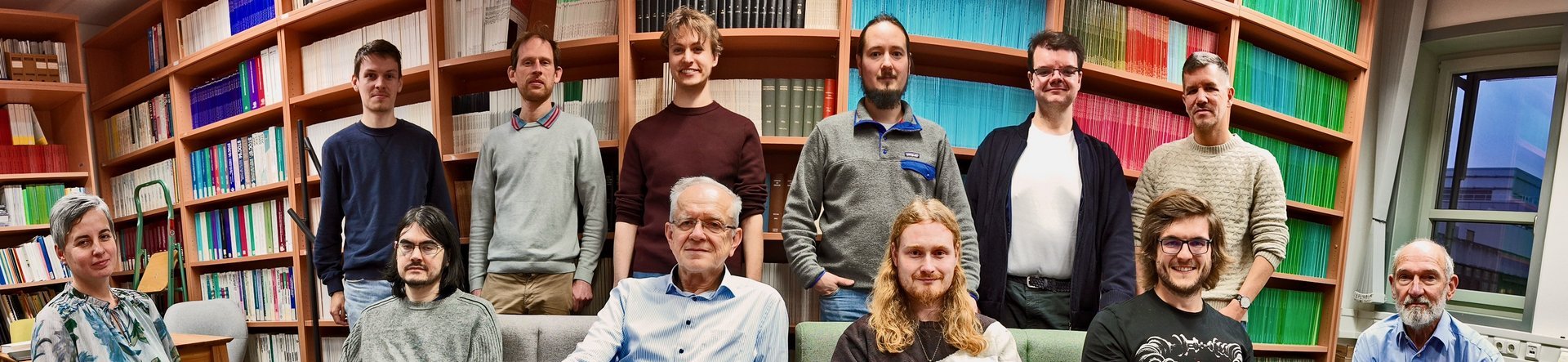
Prof. Dr. Maciej Liśkiewicz
Prof. Dr. Maciej Liskiewicz
Institutsprofessor
| E-mail: | maciej.liskiewcz@uni-luebeck.de |
| Adresse: | Institut für Thoeretische Informatik Ratzburger Allee 160 23562 Lübeck |
| Telefon: | +49 451 3101 5312 |
| Raum: | 14, 64 |

Lebenslauf
| 1976 | Abitur in Toruń, Polen |
| 1976 – 1981 | Studium an der Universität Wrocław |
| 1981 | Diplom in Informatik an der Universität Wrocław |
| 1981-1999 | Assistent und dann Adjunkt am Institut für Informatik, Universität Wrocław |
| 1990 | Promotion, Universität Wrocław |
| 1991-1993 | Post-Doc, Alexander von Humboldt-Stipendiat, TU Darmstadt (2 Jahre) |
| 1996 | Visiting Scientist Int. Computer Science Institute (ICSI), Berkeley (1 Jahr) |
| 1998 | Visiting Scientist, Eberhard-Karls-Universität Tübingen (1 Jahr) |
| 2000 | Habilitation, Universität Wrocław |
| 1999-2012 | Dozent, Universität zu Lübeck |
| 2012 – heute | apl. Professor der Universität zu Lübeck |
Preise und Stipendien
| 2026 | Top Area Chair at NeurIPS conference |
| 2022 | Top Reviewer at AISTATS: Conference on Artificial Intelligence and Statistics |
| 2021 | AAAI Distinguished Paper Award for our paper "Polynomial-Time Algorithms for Counting and Sampling Markov Equivalent DAGs" at AAAI Conference on Artificial Intelligence |
| 2021 | Best Student Paper Award for our paper (first author: Marcel Wienöbst) "Extendability of Causal Graphical Models: Algorithms and Computational Complexity" at Conference on Uncertainty in Artificial Intelligence (UAI) |
| 2014 | IBM Best Student Paper Award for our paper (first author: Benito van der Zander) "Constructing Separators and Adjustment Sets in Ancestral Graphs" at Conference on Uncertainty in Artificial Intelligence (UAI) |
| 2010 | Nominated for best paper award at GECCO conference 2010 for our paper "Negative selection algorithms without generating detectors" |
| 1991-1992 | Alexander von Humboldt-Stipendium |
2017
S.
Berndt
M.
Liskiewicz, 2017, S. 1649-1660 . 12 S.
Algorithm Substitution Attacks from a Steganographic Perspective , Computer and Communications Security
Algorithm Substitution Attacks from a Steganographic Perspective , Computer and Communications Security
@inproceedings{dde6c2a83a8f42859c7967709cddbfca,title = "Algorithm Substitution Attacks from a Steganographic Perspective",abstract = "The goal of an algorithm substitution attack (ASA), also called a subversion attack (SA), is to replace an honest implementation of a cryptographic tool by a subverted one which allows to leak private information while generating output indistinguishable from the honest output. Bellare, Paterson, and Rogaway provided at CRYPTO '14 a formal security model to capture this kind of attacks and constructed practically implementable ASAs against a large class of symmetric encryption schemes. At CCS'15, Ateniese, Magri, and Venturi extended this model to allow the attackers to work in a fully-adaptive and continuous fashion and proposed subversion attacks against digital signature schemes. Both papers also showed the impossibility of ASAs in cases where the cryptographic tools are deterministic. Also at CCS'15, Bellare, Jaeger, and Kane strengthened the original model and proposed a universal ASA against sufficiently random encryption schemes. In this paper we analyze ASAs from the perspective of steganography-the well known concept of hiding the presence of secret messages in legal communications. While a close connection between ASAs and steganography is known, this lacks a rigorous treatment. We consider the common computational model for secret-key steganography and prove that successful ASAs correspond to secure stegosystems on certain channels and vice versa. This formal proof allows us to conclude that ASAs are stegosystems and to {"}rediscover{"} several results concerning ASAs known in the steganographic literature.",author = "Sebastian Berndt and Maciej Liskiewicz",year = "2017",month = oct,day = "30",doi = "10.1145/3133956.3133981",language = "English",isbn = "978-1-4503-4946-8",series = "The ACM Conference on Computer and Communications Security (CCS)",publisher = "ACM",pages = "1649--1660 ",booktitle = "CCS '17 Proceedings of the 2017 ACM SIGSAC Conference on Computer and Communications Security",note = "Computer and Communications Security ; Conference date: 30-10-2017 Through 03-11-2017",url = "https://ccs2017.sigsac.org/",}
S.
Berndt
M.
Liskiewicz
M.
Lutter
R.
Reischuk, 2017, S. 1749-1755. 26 S.
Learning Residual Alternating Automata , Thirty-First AAAI Conference on Artificial Intelligence<br/>
Learning Residual Alternating Automata , Thirty-First AAAI Conference on Artificial Intelligence<br/>
@inproceedings{43e0450bb6e940038f10a628177e5bc8,title = "Learning Residual Alternating Automata",abstract = "Residuality plays an essential role for learning finite automata. While residual deterministic and non-deterministic automata have been understood quite well, fundamental questions concerning alternating automata (AFA) remain open. Recently, Angluin, Eisenstat, and Fisman (2015) have initiated a systematic study of residual AFAs and proposed an algorithm called AL∗-an extension of the popular L∗ algorithm-to learn AFAs. Based on computer experiments they have conjectured that AL∗ produces residual AFAs, but have not been able to give a proof. In this paper we disprove this conjecture by constructing a counterexample. As our main positive result we design an efficient learning algorithm, named AL∗∗, and give a proof that it outputs residual AFAs only. In addition, we investigate the succinctness of these different FA types in more detail.",author = "Sebastian Berndt and Maciej Liskiewicz and Matthias Lutter and R{\"u}diger Reischuk",year = "2017",month = mar,day = "8",doi = "https://aaai.org/ocs/index.php/AAAI/AAAI17/index",language = "English",isbn = "9781577357858",series = "Electronic Colloquium on Computational Complexity (ECCC)",publisher = " AAAI Press",pages = "1749--1755",editor = "Singh, \{Satinder \}",booktitle = "Proc. 31st AAAI Conference on Artificial Intelligence (AAAI 2017)",note = "Thirty-First AAAI Conference on Artificial Intelligence<br/> ; Conference date: 04-02-2017 Through 09-02-2017",url = "https://aaai.org/Conferences/AAAI/aaai17.php",}
Weitere Links:
M.
Schuster
M.
Liskiewicz, 2017, S. 1-66. 66 S.
New Abilities and Limitations of Spectral Graph Bisection , 25th Annual European Symposium on Algorithms (ESA 2017)<br/>
New Abilities and Limitations of Spectral Graph Bisection , 25th Annual European Symposium on Algorithms (ESA 2017)<br/>
@inproceedings{ab8383b370864234aa92e15ca2ced70a,title = "New Abilities and Limitations of Spectral Graph Bisection",abstract = "Spectral based heuristics belong to well-known commonly used methods which determines provably minimal graph bisection or outputs {"}fail{"} when the optimality cannot be certified. In this paper we focus on Boppana's algorithm which belongs to one of the most prominent methods of this type. It is well known that the algorithm works well in the random planted bisection model -The standard class of graphs for analysis minimum bisection and relevant problems. In 2001 Feige and Kilian posed the question if Boppana's algorithm works well in the semirandom model by Blum and Spencer. In our paper we answer this question affirmatively. We show also that the algorithm achieves similar performance on graph classes which extend the semirandom model. Since the behavior of Boppana's algorithm on the semirandom graphs remained unknown, Feige and Kilian proposed a new semidefinite programming (SDP) based approach and proved that it works on this model. The relationship between the performance of the SDP based algorithm and Boppana's approach was left as an open problem. In this paper we solve the problem in a complete way by proving that the bisection algorithm of Feige and Kilian provides exactly the same results as Boppana's algorithm. As a consequence we get that Boppana's algorithm achieves the optimal threshold for exact cluster recovery in the stochastic block model. On the other hand we prove some limitations of Boppana's approach: We show that if the density difference on the parameters of the planted bisection model is too small then the algorithm fails with high probability in the model.",author = "Schuster, \{Martin R.\} and Maciej Liskiewicz",year = "2017",month = jan,day = "5",doi = "10.4230/LIPIcs.ESA.2017.66",language = "English",isbn = "978-3-95977-049-1",volume = "87",series = "Leibniz International Proceedings in Informatics (LIPIcs)",publisher = "Schloss Dagstuhl - Leibniz-Zentrum f{\"u}r Informatik",pages = "1--66",editor = "Pruhs, \{Kirk \} and Sohler, \{Christian \}",booktitle = "25th Annual European Symposium on Algorithms (ESA 2017)",note = "25th Annual European Symposium on Algorithms (ESA 2017)<br/> ; Conference date: 04-09-2017 Through 08-09-2017",url = "https://algo2017.ac.tuwien.ac.at/esa/",}
M.
Liskiewicz
M.
Lutter
R.
Reischuk, 2017, S. 13 - 36. 24 S.
Proper Learning of k-term DNF Formulas from Satisfying Assignments
Proper Learning of k-term DNF Formulas from Satisfying Assignments
@article{d6ca796e6c7d48558837997ca8bd46cf,title = "Proper Learning of k-term DNF Formulas from Satisfying Assignments",abstract = "In certain applications there may only be positive samples available to to learn concepts of a class of interest, and this has to be done properly, i.e. the hypothesis space has to coincide with the concept class, and without false positives, i.e. the hypothesis always has be a subset of the real concept (one-sided error). For the well studied class of k-term DNF formulas it has been known that learning is difficult. Unless RP = NP, it is not feasible to learn k-term DNF formulas properly in a distribution-free sense even if both positive and negative samples are available and even if false positives are allowed. This paper constructs an efficient algorithm that for arbitrary fixed k, if samples are drawn from distributions like uniform or q-bounded ones, properly learns the class of k-term DNFs without false positives from positive samples alone with arbitrarily small relative error. ",author = "Maciej Liskiewicz and Matthias Lutter and R{\"u}diger Reischuk",year = "2017",month = jul,day = "1",language = "English",pages = "13 -- 36",journal = "Electronic Colloquium on Computational Complexity (ECCC)",issn = "1433-8092",}
Weitere Links:
M.
Liśkiewicz
R.
Reischuk
U.
Wölfel, 2017, S. 25-45. 21 S.
Security levels in steganography – Insecurity does not imply detectability
Security levels in steganography – Insecurity does not imply detectability
@article{41df6b54e7914af9b455be418a63d4e5,title = "Security levels in steganography {\textendash} Insecurity does not imply detectability",abstract = "This paper takes a fresh look at security notions for steganography {\textendash} the art of encoding secret messages into unsuspicious covertexts such that an adversary cannot distinguish the resulting stegotexts from original covertexts. However, stegosystems that fulfil the security notion used so far are quite inefficient. The current setting is not able to quantify the power of the adversary and thus leads to extremely high requirements. We will show that there exist stegosystems that are not secure with respect to the measure insecurity considered so far. However, it is totally unclear how they could be successfully attacked when used in practice. This indicates that a different notion of security is needed which we call detectability. We propose different variants of (un)-detectability and discuss their appropriateness by constructing concrete examples of stegosystems and covertext distributions. As main technical contribution we design a framework for steganography that exploits the difficulty to get detailed information about the covertext distribution. This way, for the first time a tight analytical relationship between the task of discovering the use of stegosystems and the task of differentiating between possible covertext distributions is obtained.",author = "Maciej Li{\'s}kiewicz and R{\"u}diger Reischuk and Ulrich W{\"o}lfel",year = "2017",month = sep,day = "5",doi = "10.1016/j.tcs.2017.06.007",language = "English",volume = "692",pages = "25--45",journal = "Theoretical Computer Science",issn = "0304-3975",publisher = "Elsevier B.V.",}
2016
S.
Berndt
M.
Liskiewicz, 2016. 16 S.
Hard Communication Channels for Steganography , 27th International Symposium on Algorithms and Computation (ISAAC 2016)<br/>
Hard Communication Channels for Steganography , 27th International Symposium on Algorithms and Computation (ISAAC 2016)<br/>
@inproceedings{5d2e39877cae4fa7ab9065f61a36df10,title = "Hard Communication Channels for Steganography",abstract = "This paper considers steganography - the concept of hiding the presence of secret messages in legal communications - in the computational setting and its relation to cryptography. Very recently the first (non-polynomial time) steganographic protocol has been shown which, for any communication channel, is provably secure, reliable, and has nearly optimal bandwidth. The security is unconditional, i.e. it does not rely on any unproven complexity-theoretic assumption. This disproves the claim that the existence of one-way functions and access to a communication channel oracle are both necessary and sufficient conditions for the existence of secure steganography in the sense that secure and reliable steganography exists independently of the existence of one-way functions. In this paper, we prove that this equivalence also does not hold in the more realistic setting, where the stegosystem is polynomial time bounded. We prove this by constructing (a) a channel for which secure steganography exists if and only if one-way functions exist and (b) another channel such that secure steganography implies that no one-way functions exist. We therefore show that security-preserving reductions between cryptography and steganography need to be treated very carefully.",author = "Sebastian Berndt and Maciej Liskiewicz",year = "2016",month = dec,day = "2",doi = "10.4230/LIPIcs.ISAAC.2016.16",language = "English",isbn = "978-3-95977-026-2",volume = "64",series = "Leibniz International Proceedings in Informatics (LIPIcs)",publisher = "Schloss Dagstuhl - Leibniz-Zentrum f{\"u}r Informatik",editor = "Hong, \{Seok-Hee \}",booktitle = "27th International Symposium on Algorithms and Computation (ISAAC 2016)",note = "27th International Symposium on Algorithms and Computation (ISAAC 2016)<br/> ; Conference date: 12-12-2016 Through 14-12-2016",url = "http://rp-www.cs.usyd.edu.au/\textasciitilde{}visual/isaac2016/",}
B.
Zander
M.
Liskiewicz, 2016, S. 1214-1222. 9 S.
On Searching for Generalized Instrumental Variables , Proceedings of the 19th International Conference on Artificial Intelligence and Statistics
On Searching for Generalized Instrumental Variables , Proceedings of the 19th International Conference on Artificial Intelligence and Statistics
@inproceedings{d8aaf9775fd9415a8ccf513dbc63ef96,title = "On Searching for Generalized Instrumental Variables",abstract = "Instrumental Variables are a popular way to identify the direct causal effect of a random variable X on a variable Y. Often no single instrumental variable exists, although it is still possible to find a set of generalized instrumental variables (GIVs) and identify the causal effect of all these variables at once. Till now it was not known how to find GIVs systematically or even test efficiently, if given variables satisfy GIV conditions. We provide fast algorithms for searching and testing restricted cases of GIVs. However, we prove that in the most general case it is NP-hard to verify if given variables fulfill the conditions of a general instrumental sets.",author = "Benito Zander and Maciej Liskiewicz",year = "2016",month = sep,day = "1",language = "English",volume = "51",series = "Proceedings of Machine Learning Research",publisher = "PMLR",pages = "1214--1222",editor = "Arthur Gretton and Robert, \{Christian C.\}",booktitle = "Proceedings of the 19th International Conference on Artificial Intelligence and Statistics",note = "Proceedings of the 19th International Conference on Artificial Intelligence and Statistics ; Conference date: 09-03-2016 Through 11-03-2016",}
S.
Berndt
M.
Lískiewicz, 2016, S. 81-92. 12 S.
Provable Secure Universal Steganography of Optimal Rate , Information Hiding and Multimedia Security
Provable Secure Universal Steganography of Optimal Rate , Information Hiding and Multimedia Security
@inproceedings{d1ba2385c18a493296a5f71cf13a56c3,title = "Provable Secure Universal Steganography of Optimal Rate",abstract = "We present the first complexity-Theoretic secure steganographic protocol which, for any communication channel, is provably secure, reliable, and has nearly optimal bandwidth. Our system is unconditionally secure, i.e. our proof does not rely on any unproven complexity-Theoretic assumption, like e.g. the existence of one-way functions. This disproves the claim that the existence of one-way functions and access to a communication channel oracle are both necessary and sufficient conditions for the existence of secure steganography, in the sense that secure and reliable steganography exists independently of the existence of one-way functions.",author = "Sebastian Berndt and Maciej L{\'i}skiewicz",year = "2016",month = jun,day = "20",doi = "10.1145/2909827.2930796",language = "English",isbn = "978-1-4503-4290-2",pages = "81--92",booktitle = "IH\&MMSec '16",publisher = "ACM",note = "Information Hiding and Multimedia Security ; Conference date: 20-06-2016 Through 22-06-2016",}
J.
Textor
B.
van der Zander
M.
Gilthorpe
M.
Liskiewicz
G.
Ellison, 2016, S. 1887-1894. 8 S.
Robust causal inference using directed acyclic graphs: The R package 'dagitty'
Robust causal inference using directed acyclic graphs: The R package 'dagitty'
@article{863e781446a747cfadc85431b665a10b,title = "Robust causal inference using directed acyclic graphs: The R package 'dagitty'",abstract = "Directed acyclic graphs (DAGs), which offer systematic representations of causal relationships, have become an established framework for the analysis of causal inference in epidemiology, often being used to determine covariate adjustment sets for minimizing confounding bias. DAGitty is a popular web application for drawing and analysing DAGs. Here we introduce the R package 'dagitty', which provides access to all of the capabilities of the DAGitty web application within the R platform for statistical computing, and also offers several new functions. We describe how the R package 'dagitty' can be used to: evaluate whether a DAG is consistent with the dataset it is intended to represent; enumerate 'statistically equivalent' but causally different DAGs; and identify exposureoutcome adjustment sets that are valid for causally different but statistically equivalent DAGs. This functionality enables epidemiologists to detect causal misspecifications in DAGs and make robust inferences that remain valid for a range of different DAGs. The R package 'dagitty' is available through the comprehensive R archive network (CRAN) at [https://cran.r-project.org/web/packages/dagitty/]. The source code is available on github at [https://github.com/jtextor/dagitty]. The web application 'DAGitty' is free software, licensed under the GNU general public licence (GPL) version 2 and is available at [http:// dagitty.net/].",author = "Johannes Textor and \{van der Zander\}, Benito and Gilthorpe, \{Mark S.\} and Maciej Liskiewicz and Ellison, \{George TH\}",year = "2016",month = dec,day = "1",doi = "10.1093/ije/dyw341",language = "English",volume = "45",pages = "1887--1894",journal = "International Journal of Epidemiology",issn = "0300-5771",publisher = "Oxford University Press",number = "6",}
B.
Van Der Zander
M.
Lískiewicz, 2016, S. 3315-3321. 7 S.
Separators and Adjustment Sets in Markov Equivalent DAGs. , Thirtieth AAAI Conference on Artificial Intelligence<br/>
Separators and Adjustment Sets in Markov Equivalent DAGs. , Thirtieth AAAI Conference on Artificial Intelligence<br/>
@inproceedings{37663c147ec145828cd08d4d6799c710,title = "Separators and Adjustment Sets in Markov Equivalent DAGs.",abstract = "In practice the vast majority of causal effect estimations from observational data are computed using adjustment sets which avoid confounding by adjusting for appropriate covariates. Recently several graphical criteria for selecting adjustment sets have been proposed. They handle causal directed acyclic graphs (DAGs) as well as more general types of graphs that represent Markov equivalence classes of DAGs, including completed partially directed acyclic graphs (CPDAGs). Though expressed in graphical language, it is not obvious how the criteria can be used to obtain effective algorithms for finding adjustment sets. In this paper we provide a new criterion which leads to an efficient algorithmic framework to find, test and enumerate covariate adjustments for chain graphs - mixed graphs representing in a compact way a broad range of Markov equivalence classes of DAGs.",author = "\{Van Der Zander\}, Benito and Maciej L{\'i}skiewicz",year = "2016",month = mar,day = "5",language = "English",series = "AAAI Conference on Artificial Intelligence",publisher = " AAAI Press",pages = "3315--3321",booktitle = "Thirtieth AAAI Conference on Artificial Intelligence",note = "Thirtieth AAAI Conference on Artificial Intelligence<br/> ; Conference date: 12-02-2016 Through 17-02-2016",url = "https://www.aaai.org/ocs/index.php/AAAI/AAAI16/index",}