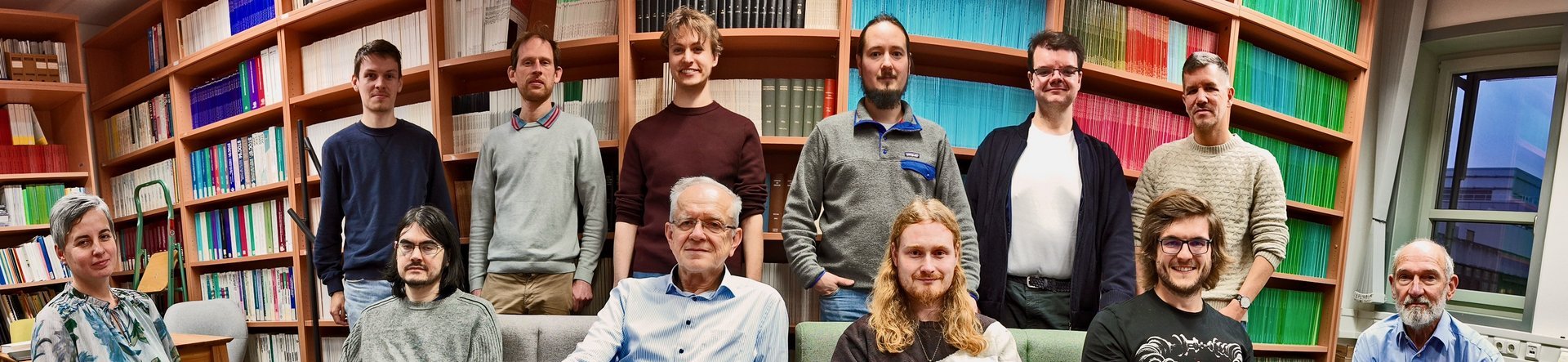
Prof. Dr. Rüdiger Reischuk
Prof. Dr. math. Rüdiger Reischuk
emeritus Institutsprofessor
| E-mail: | ruediger.reischuk@uni-luebeck.de |
| Adresse: | Institut für Theoretische Informatik Ratzeburger Allee 160 23562 Lübeck |
| Telefon: | +49 451 3101 5310 |
| Raum: | Raum 2083, Gebäude 64 |

Lebenslauf
| 1975 | geboren in Berlin |
| 1984 – 1990 | Jugendzeit in Windhuk, Namibia |
| 1994 | Abitur in Berlin |
| 1994 – 1999 | Studium an der TU Berlin |
| 1995 | Grundwehrdienst |
| 1999 | Diplom in Informatik an der TU Berlin |
| 1999 – 2005 | Wissenschaftlicher Mitarbeiter am Lehrstuhl Prof. Siefkes, TU Berlin |
| 2001 | Diplom in Mathematik an der TU Berlin |
| 2003 | Promotion zum Dr. rer.-nat. an der TU Berlin |
| 2004 | Einjähriger Forschungsaufenthalt bei Richard Karp am ICSI, Berkeley |
| 2005 | Ernennung zum Universitätsprofessor für Theoretische Informatik an der Universität zu Lübeck (W2) |
| 2007 | Verpartnerung mit Carsten Lenz |
| 2008 – 2025 | Studiendekan der Technisch-Naturwissenschaftlichen Fakultät, später der MINT-Sektionen |
| 2014 – 2020 | Vorsitzender des Wissenschaftlichen Beirats des Bundeswettbewerbs Informatik |
| 2015 | Ernennung zum W3-Professor an der Universität zu Lübeck |
| 2023 – heute | Vizepräsident der Universität zu Lübeck |
Positionen und Ämter
Preise und Stipendien
| 1993 | Silbermedaille bei der Internationalen Olympiade der Informatik in Mendoza, Argentinien |
| 1993 | Studienstipendium durch die Studienstiftung des Deutschen Volkes |
| 1994 | Dr. Habbena Preis für ein sehr gutes Abitur |
| 1999 | Erwin-Stephan-Preis der TU Berlin |
| 2002 | Best student paper award bei der MFCS 2002 |
| 2003 | Doktorarbeit wird für den GI-Dissertationspreis vorgeschlagen |
| 2007, 2010, 2014, 2018, 2021 | Lehrpreise der Studierenden der technisch-naturwissenschaftlichen Fakultät / der MINT-Sektionen (Heliprof 2007, Heliprof 2010, Heliprof 2014, Heliprof 2018, Heliprof 2021) |
2020
M.
Bannach
M.
Skambath
T.
Tantau, 2020, S. 9:1-9:16
Kernelizing the Hitting Set Problem in Linear Sequential and Constant Parallel Time. , 17th Scandinavian Symposium and Workshops on Algorithm Theory
Kernelizing the Hitting Set Problem in Linear Sequential and Constant Parallel Time. , 17th Scandinavian Symposium and Workshops on Algorithm Theory
@conference{ef12d91d845c4197b2dfdd065a5a3eda,title = "Kernelizing the Hitting Set Problem in Linear Sequential and Constant Parallel Time.",abstract = "We analyze a reduction rule for computing kernels for the hitting set problem: In a hypergraph, the link of a set c of vertices consists of all edges that are supersets of c. We call such a set critical if its link has certain easy-to-check size properties. The rule states that the link of a critical c can be replaced by c. It is known that a simple linear-time algorithm for computing hitting set kernels (number of edges) at most k\textasciicircum{}d (k is the hitting set size, d is the maximum edge size) can be derived from this rule. We parallelize this algorithm and obtain the first AC⁰ kernel algorithm that outputs polynomial-size kernels. Previously, such algorithms were not even known for artificial problems. An interesting application of our methods lies in traditional, non-parameterized approximation theory: Our results imply that uniform AC⁰-circuits can compute a hitting set whose size is polynomial in the size of an optimal hitting set. ",author = "Max Bannach and Malte Skambath and Till Tantau",note = "DBLP's bibliographic metadata records provided through http://dblp.org/search/publ/api are distributed under a Creative Commons CC0 1.0 Universal Public Domain Dedication. Although the bibliographic metadata records are provided consistent with CC0 1.0 Dedication, the content described by the metadata records is not. Content may be subject to copyright, rights of privacy, rights of publicity and other restrictions.; 17th Scandinavian Symposium and Workshops on Algorithm Theory, SWAT 2020 ; Conference date: 12-06-2020 Through 12-06-2020",year = "2020",doi = "10.4230/LIPICS.SWAT.2020.9",language = "English",pages = "9:1--9:16",url = "https://www.setur.fo/en/education/swat-2020/",}
2019
M.
Bannach
T.
Tantau, 2019, S. 13:1--13:14. 14 S.
Computing kernels in parallel: Lower and upper bounds , 13th International Symposium on Parameterized and Exact Computation
Computing kernels in parallel: Lower and upper bounds , 13th International Symposium on Parameterized and Exact Computation
@inproceedings{5630ed8a3b6b445388b3f1cebe9ced79,title = "Computing kernels in parallel: Lower and upper bounds",abstract = "Parallel fixed-parameter tractability studies how parameterized problems can be solved in parallel. A surprisingly large number of parameterized problems admit a high level of parallelization, but this does not mean that we can also efficiently compute small problem kernels in parallel: known kernelization algorithms are typically highly sequential. In the present paper, we establish a number of upper and lower bounds concerning the sizes of kernels that can be computed in parallel. An intriguing finding is that there are complex trade-offs between kernel size and the depth of the circuits needed to compute them: For the vertex cover problem, an exponential kernel can be computed by AC0-circuits, a quadratic kernel by TC0-circuits, and a linear kernel by randomized NC-circuits with derandomization being possible only if it is also possible for the matching problem. Other natural problems for which similar (but quantitatively different) effects can be observed include tree decomposition problems parameterized by the vertex cover number, the undirected feedback vertex set problem, the matching problem, or the point line cover problem. We also present natural problems for which computing kernels is inherently sequential.",author = "Max Bannach and Till Tantau",note = "Publisher Copyright: {\textcopyright} Max Bannach and Till Tantau; licensed under Creative Commons License CC-BY. Copyright: Copyright 2020 Elsevier B.V., All rights reserved.; 13th International Symposium on Parameterized and Exact Computation , IPEC 2018 ; Conference date: 22-08-2018 Through 24-08-2018",year = "2019",month = jan,day = "1",doi = "10.4230/LIPIcs.IPEC.2018.13",language = "English",isbn = "978-3-95977-084-2",volume = "115",series = "Leibniz International Proceedings in Informatics (LIPIcs)",publisher = "Schloss Dagstuhl - Leibniz-Zentrum f{\"u}r Informatik",pages = "13:1----13:14",editor = "Paul, \{Christophe \} and Pilipczuk, \{Michal \}",booktitle = "13th International Symposium on Parameterized and Exact Computation (IPEC 2018)",}
M.
Bannach
Z.
Heinrich
R.
Reischuk
T.
Tantau, 2019. 24 S.
Dynamic Kernels for Hitting Sets and Set Packing
Dynamic Kernels for Hitting Sets and Set Packing
@book{62496cc489b0413b89851409a6c7f9ff,title = "Dynamic Kernels for Hitting Sets and Set Packing",abstract = "Computing kernels for the hitting set problem (the problem of finding a size-k set that intersects each hyperedge of a hypergraph) is a well-studied computational problem. For hypergraphs with m hyperedges, each of size at most d, the best algorithms can compute kernels of size O(kd) in time O(2dm). In this paper we generalize the task to the dynamic setting where hyperedges may be continuously added and deleted and we always have to keep track of a hitting set kernel (including moments when no size-k hitting set exists). We present a deterministic solution, based on a novel data structure, that needs worst-case time O∗(3d) for updating the kernel upon hyperedge inserts and time O∗(5d) for updates upon deletions {\textendash} thus nearly matching the time O∗(2d) needed by the best static algorithm per hyperedge. As a novel technical feature, our approach does not use the standard replace- sunflowers-by-their-cores methodology, but introduces a generalized concept that is actually easier to compute and that allows us to achieve a kernel size of ﰆdi=0 ki rather than the typical size d! · kd resulting from the Sunflower Lemma. We also show that our approach extends to the dual problem of finding packings in hypergraphs (the problem of finding k pairwise disjoint hyperedges), albeit with a slightly larger kernel size of ﰆdi=0 di(k − 1)i.",author = "Max Bannach and Zacharias Heinrich and R{\"u}diger Reischuk and Till Tantau",year = "2019",month = oct,day = "31",language = "English",publisher = "Computational Complexity Foundation (CCF)",}
M.
Bannach
T.
Tantau, 2019, S. 11:1--11:16. 16 S.
On the Descriptive Complexity of Color Coding , 36th International Symposium on Theoretical Aspects of Computer Science
On the Descriptive Complexity of Color Coding , 36th International Symposium on Theoretical Aspects of Computer Science
@inproceedings{0885b150372e4873b2f45f8a89074d6b,title = "On the Descriptive Complexity of Color Coding",abstract = "Color coding is an algorithmic technique used in parameterized complexity theory to detect {\textquotedblleft}small{\textquotedblright} structures inside graphs. The idea is to derandomize algorithms that first randomly color a graph and then search for an easily-detectable, small color pattern. We transfer color coding to the world of descriptive complexity theory by characterizing {\textendash} purely in terms of the syntactic structure of describing formulas {\textendash} when the powerful second-order quantifiers representing a random coloring can be replaced by equivalent, simple first-order formulas. Building on this result, we identify syntactic properties of first-order quantifiers that can be eliminated from formulas describing parameterized problems. The result applies to many packing and embedding problems, but also to the long path problem. Together with a new result on the parameterized complexity of formula families involving only a fixed number of variables, we get that many problems lie in fpt just because of the way they are commonly described using logical formulas.",author = "Max Bannach and Till Tantau",note = "Publisher Copyright: {\textcopyright} Max Bannach and Till Tantau. Copyright: Copyright 2019 Elsevier B.V., All rights reserved.; 36th International Symposium on Theoretical Aspects of Computer Science , STACS 2019 ; Conference date: 13-03-2019 Through 16-03-2019",year = "2019",month = mar,day = "1",doi = "10.4230/LIPIcs.STACS.2019.11",language = "English",isbn = "978-3-95977-100-9",volume = "126",series = "Leibniz International Proceedings in Informatics (LIPIcs)",publisher = "Schloss Dagstuhl - Leibniz-Zentrum f{\"u}r Informatik",pages = "11:1----11:16",editor = "Rolf Niedermeier and Paul, \{ Christophe\}",booktitle = "36th International Symposium on Theoretical Aspects of Computer Science (STACS 2019)",}
C.
Herzog
N.
Hoffmann
T.
Tantau
P.
Rostalski, 2019, S. 17-19. 3 S.
Study program "Robotics and autonomous systems" at the University of Lübeck , 2018 12th European Workshop on Microelectronics Education (EWME)
Study program "Robotics and autonomous systems" at the University of Lübeck , 2018 12th European Workshop on Microelectronics Education (EWME)
@inproceedings{c89a98a88be74c3e93f49abfa2c096fe,title = "Study program {"}Robotics and autonomous systems{"} at the University of L{\"u}beck",abstract = "Designing robotic and autonomous systems requires diverse skills from various engineering disciplines such as electronics, mechatronics, control and signal processing together with state of the art computer science such as software architecture, algorithms and datastructures or artificial intelligence. In order to address current and future technological and societal challenges, a novel consecutive set of bachelor and master study programs in {"}Robotics and Autonomous Systems{"} got established at the University of L{\"u}beck in 2016. The program aims to cater to academia's and the industry's increasing demand for highly qualified experts in this emerging intersection of disciplines. In the three registration periods in 2016, 2017, and 2018, the program was exceptionally well-received. The program evolved out of an established computer science major degree in {"}Robotics and Automation{"} into a standalone study program by incorporating innovative new courses from important current research fields handled by freshly hired professors with backgrounds in medical support systems, machine learning and mobile swarm robotics. Ethical and societal challenges associated with autonomous systems are addressed by a course building on project-based innovative teaching methods and public engagement.",author = "C. Herzog and N{\'e} Hoffmann and T. Tantau and P. Rostalski",year = "2019",month = jan,day = "29",doi = "10.1109/EWME.2018.8629446",language = "English",isbn = "978-1-5386-9115-1",pages = "17--19",booktitle = "2018 12th European Workshop on Microelectronics Education (EWME)",publisher = "IEEE",note = "12th European Workshop on Microelectronics Education, EWME 2018 ; Conference date: 24-09-2018 Through 26-09-2018",url = "http://ewme2018.iti.uni-luebeck.de/",}
2018
M.
Bannach
T.
Tantau, 2018
Computing Hitting Set Kernels By AC^0-Circuits
Computing Hitting Set Kernels By AC^0-Circuits
@article{ac22e43d1f7a4fc680cd4ba2cc3fe783,title = "Computing Hitting Set Kernels By AC\textasciicircum{}0-Circuits",abstract = "Given a hypergraph H = (V,E), what is the smallest subset X of V such that e and X are not disjoint for all e in E? This problem, known as the hitting set problem, is a basic problem in parameterized complexity theory. There are well-known kernelization algorithms for it, which get a hypergraph H and a number k as input and output a hypergraph H' such that (1) H has a hitting set of size k if, and only if, H' has such a hitting set and (2) the size of H' depends only on k and on the maximum cardinality d of edges in H. The algorithms run in polynomial time, but are highly sequential. Recently, it has been shown that one of them can be parallelized to a certain degree: one can compute hitting set kernels in parallel time O(d) - but it was conjectured that this is the best parallel algorithm possible. We refute this conjecture and show how hitting set kernels can be computed in constant parallel time. For our proof, we introduce a new, generalized notion of hypergraph sunflowers and show how iterated applications of the color coding technique can sometimes be collapsed into a single application.",author = "Max Bannach and Till Tantau",year = "2018",doi = "10.4230/LIPIcs.STACS.2018.9",language = "English",volume = "abs/1801.00716",journal = "CoRR",}
Weitere Links:
M.
Bannach
M.
Skambath
T.
Tantau, 2018, S. 341-353. 13 S.
Towards Work-Efficient Parallel Parameterized Algorithms , 13th International Conference and Workshop on Algorithms and Computations <br/>
Towards Work-Efficient Parallel Parameterized Algorithms , 13th International Conference and Workshop on Algorithms and Computations <br/>
@inproceedings{433ea73bed0346298ca2a24beb7cce29,title = "Towards Work-Efficient Parallel Parameterized Algorithms",abstract = "Parallel parameterized complexity theory studies how fixed-parameter tractable (fpt) problems can be solved in parallel. Previous theoretical work focused on parallel algorithms that are very fast in principle, but did not take into account that when we only have a small number of processors (between 2 and, say,{\^A} 1024), it is more important that the parallel algorithms are work-efficient. In the present paper we investigate how work-efficient fpt algorithms can be designed. We review standard methods from fpt theory, like kernelization, search trees, and interleaving, and prove trade-offs for them between work efficiency and runtime improvements. This results in a toolbox for developing work-efficient parallel fpt algorithms.",author = "Max Bannach and Malte Skambath and Till Tantau",note = "Publisher Copyright: {\textcopyright} 2019, Springer Nature Switzerland AG. Copyright: Copyright 2019 Elsevier B.V., All rights reserved.; 13th International Conference and Workshop on Algorithms and Computations <br/>, WALCOM 2019 ; Conference date: 27-02-2019 Through 02-03-2019",year = "2018",month = dec,day = "21",doi = "10.1007/978-3-030-10564-8\_27",language = "English",isbn = "978-3-030-10563-1",volume = "11355 LNCS",series = "Lecture Notes in Computer Science ",publisher = "Springer, Cham",pages = "341--353",editor = "\{K. Das\}, \{Gautam \} and \{S. Mandal\}, \{Partha \} and \{Krishnendu Mukhopadhyaya\} and Nakano, \{Shin-ichi \}",booktitle = "WALCOM 2019: WALCOM: Algorithms and Computation",}
2017
T.
Tantau, 2017, S. 1-4. 5 S.
Applications of Algorithmic Metatheorems to Space Complexity and Parallelism (Invited Talk) , 34th Symposium on Theoretical Aspects of Computer Science (STACS 2017)<br/>
Applications of Algorithmic Metatheorems to Space Complexity and Parallelism (Invited Talk) , 34th Symposium on Theoretical Aspects of Computer Science (STACS 2017)<br/>
@inproceedings{5022b610610b44c386523ca9998c165b,title = "Applications of Algorithmic Metatheorems to Space Complexity and Parallelism (Invited Talk)",abstract = "Algorithmic metatheorems state that if a problem can be described in a certain logic and the inputs are structured in a certain way, then the problem can be solved with a certain amount of resources. As an example, by Courcelle's Theorem all monadic second-order ({"}in a certain logic{"}) properties of graphs of bounded tree width ({"}structured in a certain way{"}) can be solved in linear time ({"}with a certain amount of resources{"}). Such theorems have become a valuable tool in algorithmics: If a problem happens to have the right structure and can be described in the right logic, they immediately yield a (typically tight) upper bound on the time complexity of the problem. Perhaps even more importantly, several complex algorithms rely on algorithmic metatheorems internally to solve subproblems, which considerably broadens the range of applications of these theorems. The talk is intended as a gentle introduction to the ideas behind algorithmic metatheorems, especially behind some recent results concerning space classes and parallel computation, and tries to give a flavor of the range of their applications.",author = "Till Tantau",year = "2017",month = mar,day = "1",doi = "http://drops.dagstuhl.de/opus/volltexte/2017/7030/pdf/LIPIcs-STACS-2017-4.pdf",language = "English",isbn = "978-3-95977-028-6",volume = "66",series = "Leibniz International Proceedings in Informatics (LIPIcs)",publisher = "Schloss Dagstuhl - Leibniz-Zentrum f{\"u}r Informatik",pages = "1--4",editor = "Vollmer, \{Heribert \} and Vall{\'e}e, \{Brigitte \}",booktitle = "34th Symposium on Theoretical Aspects of Computer Science (STACS 2017)",note = "34th Symposium on Theoretical Aspects of Computer Science (STACS 2017)<br/> ; Conference date: 08-03-2017 Through 11-03-2017",url = "https://stacs2017.thi.uni-hannover.de/",}
M.
Bannach
T.
Tantau, 2017, S. 4 - 17. 14 S.
Parallel Multivariate Meta-Theorems , 11th International Symposium on Parameterized and Exact Computation (IPEC 2016)<br/>
Parallel Multivariate Meta-Theorems , 11th International Symposium on Parameterized and Exact Computation (IPEC 2016)<br/>
@inproceedings{6137ce64072d44c0bba6b6e42edfd476,title = "Parallel Multivariate Meta-Theorems",abstract = "Fixed-parameter tractability is based on the observation that many hard problems become tractable even on large inputs as long as certain input parameters are small. Originally, ``tractable'' just meant ``solvable in polynomial time,'' but especially modern hardware raises the question of whether we can also achieve ``solvable in polylogarithmic parallel time.'' A framework for this study of \textbackslash{}emph\{parallel fixed-parameter tractability\} is available and a number of isolated algorithmic results have been obtained in recent years, but one of the unifying core tools of classical FPT theory has been missing: algorithmic meta-theorems. We establish two such theorems by giving new upper bounds on the circuit depth necessary to solve the model checking problem for monadic second-order logic, once parameterized by the tree width and the formula (this is a parallel version of Courcelle's Theorem) and once by the tree depth and the formula. For our proofs we refine the analysis of earlier algorithms, especially of Bodlaender's, but also need to add new ideas, especially in the context where the parallel runtime is bounded by a function of the parameter and does not depend on the length of the input.",author = "Max Bannach and Till Tantau",year = "2017",month = feb,day = "1",doi = "10.4230/LIPIcs.IPEC.2016.4",language = "English",isbn = "978-3-95977-023-1",volume = "63",series = "Leibniz International Proceedings in Informatics (LIPIcs)",publisher = "Schloss Dagstuhl - Leibniz-Zentrum f{\"u}r Informatik",pages = "4 -- 17",editor = "\{Guo \}, \{Jiong \} and Hermelin, \{Danny \}",booktitle = "11th International Symposium on Parameterized and Exact Computation (IPEC 2016)",note = "11th International Symposium on Parameterized and Exact Computation (IPEC 2016)<br/> ; Conference date: 24-08-2016 Through 26-08-2016",url = "http://drops.dagstuhl.de/portals/extern/index.php?semnr=16026",}
2016
T.
Tantau, 2016
A Gentle Introduction to Applications of Algorithmic Metatheorems for Space and Circuit Classes
A Gentle Introduction to Applications of Algorithmic Metatheorems for Space and Circuit Classes
@article{30e461472ab6417e97053f3d3b1c3a37,title = "A Gentle Introduction to Applications of Algorithmic Metatheorems for Space and Circuit Classes",abstract = "Algorithmic metatheorems state that if a problem can be described in a certain logic and the inputs are structured in a certain way, then the problem can be solved with a certain amount of resources. As an example, by Courcelle's Theorem, all monadic second-order ({"}in a certain logic{"}) properties of graphs of bounded tree width ({"}structured in a certain way{"}) can be solved in linear time ({"}with a certain amount of resources{"}). Such theorems have become valuable tools in algorithmics: if a problem happens to have the right structure and can be described in the right logic, they immediately yield a (typically tight) upper bound on the time complexity of the problem. Perhaps even more importantly, several complex algorithms rely on algorithmic metatheorems internally to solve subproblems, which considerably broadens the range of applications of these theorems. This paper is intended as a gentle introduction to the ideas behind algorithmic metatheorems, especially behind some recent results concerning space and circuit classes, and tries to give a flavor of the range of their applications.",author = "Till Tantau",year = "2016",month = jul,day = "9",doi = "10.3390/a9030044",language = "English",volume = "9",journal = "Algorithms",issn = "1999-4893",publisher = "Multidisciplinary Digital Publishing Institute (MDPI)",number = "3",}