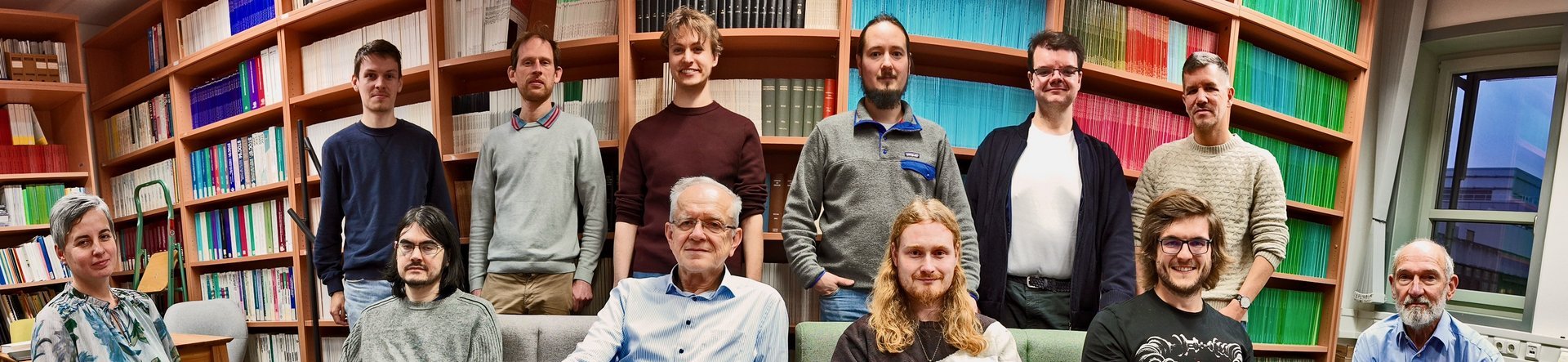
Prof. Dr. Till Tantau
Prof. Dr. Till Tantau
Institutsdirektor
| E-mail: | till.tantau@uni-luebeck.de |
| Adresse: | Institut für Theoretische Informatik Ratzeburger Allee 160 23562 Lübeck |
| Telefon: | +49 451 31015311 |
| Raum: | Raum 2082, Gebäude 64 |

Till Tantau ist Professor für Theoretische Informatik seit 2005.
Sprechstunden nach Vereinbarung über das Sekretariat.
Lebenslauf
| 1975 | geboren in Berlin |
| 1984 – 1990 | Jugendzeit in Windhuk, Namibia |
| 1994 | Abitur in Berlin |
| 1994 – 1999 | Studium an der TU Berlin |
| 1995 | Grundwehrdienst |
| 1999 | Diplom in Informatik an der TU Berlin |
| 1999 – 2005 | Wissenschaftlicher Mitarbeiter am Lehrstuhl Prof. Siefkes, TU Berlin |
| 2001 | Diplom in Mathematik an der TU Berlin |
| 2003 | Promotion zum Dr. rer.-nat. an der TU Berlin |
| 2004 | Einjähriger Forschungsaufenthalt bei Richard Karp am ICSI, Berkeley |
| 2005 | Ernennung zum Universitätsprofessor für Theoretische Informatik an der Universität zu Lübeck (W2) |
| 2007 | Verpartnerung mit Carsten Lenz |
| 2008 – 2025 | Studiendekan der Technisch-Naturwissenschaftlichen Fakultät, später der MINT-Sektionen |
| 2014 – 2020 | Vorsitzender des Wissenschaftlichen Beirats des Bundeswettbewerbs Informatik |
| 2015 | Ernennung zum W3-Professor an der Universität zu Lübeck |
| 2023 – heute | Vizepräsident der Universität zu Lübeck |
Preise und Stipendien
| 1992 | Bundessieger Informatik beim Bundeswettbewerb Informatik |
| 1993 | Silbermedaille bei der Internationalen Olympiade der Informatik in Mendoza, Argentinien |
| 1993 | Studienstipendium durch die Studienstiftung des Deutschen Volkes |
| 1994 | Dr. Habbena Preis für ein sehr gutes Abitur |
| 1999 | Erwin-Stephan-Preis der TU Berlin |
| 2002 | Best student paper award bei der MFCS 2002 |
| 2003 | Doktorarbeit wird für den GI-Dissertationspreis vorgeschlagen |
| 2007, 2010, 2014, 2018, 2021 | Lehrpreise der Studierenden der technisch-naturwissenschaftlichen Fakultät / der MINT-Sektionen (Heliprof 2007, Heliprof 2010, Heliprof 2014, Heliprof 2018, Heliprof 2021) |
Expertise
Sie können Till Tantau gerne ansprechen und auch als Experte anfragen zu den folgenden Themen:
- Forschungsfragen rund um mathematische Logik, Komplexitätstheorie, Berechenbarkeit
- Als Gutachter für Akkreditierung von Studiengängen und verwandte Themen
- Grundsatzfragen rund um das Thema TeX
Positionen und Ämter
| 2008 – 2025 | Studiendekan der Technisch-Naturwissenschaftlichen Fakultät, später der MINT-Sektionen |
| 2014 – 2020 | Vorsitzender des Wissenschaftlichen Beirats des Bundeswettbewerbs Informatik |
| 2023 – heute | Vizepräsident der Universität zu Lübeck für Lehre |
2026
F.
Chudigiewitsch
T.
Tantau
F.
Winkler, 2026
On the Complexity of Fundamental Problems for DAG-Compressed Graphs
On the Complexity of Fundamental Problems for DAG-Compressed Graphs
@misc{bc9e4e00aabf4cada7c71f1d516a6e6d,title = "On the Complexity of Fundamental Problems for DAG-Compressed Graphs",author = "Florian Chudigiewitsch and Till Tantau and Felix Winkler",year = "2026",doi = "10.48550/ARXIV.2603.22063",language = "English",publisher = "arXiv",type = "Other",}
F.
Chudigiewitsch
M.
Gründel
C.
Komusiewicz
N.
Morawietz
T.
Tantau, 2026, S. 93:1-93:17
The Descriptive Complexity of Relation Modification Problems , 51st International Symposium on Mathematical Foundations of Computer Science
The Descriptive Complexity of Relation Modification Problems , 51st International Symposium on Mathematical Foundations of Computer Science
@conference{a0387b904b774a94a781e17f87f4b5e5,title = "The Descriptive Complexity of Relation Modification Problems",author = "Florian Chudigiewitsch and Marlene Gr{\"u}ndel and Christian Komusiewicz and Nils Morawietz and Till Tantau",year = "2026",doi = "10.4230/LIPICS.MFCS.2026.93",language = "English",pages = "93:1--93:17",note = "51st International Symposium on Mathematical Foundations of Computer Science, MFCS ; Conference date: 24-08-2026 Through 28-08-2026",}
F.
Chudigiewitsch
M.
Gründel
C.
Komusiewicz
N.
Morawietz
T.
Tantau, 2026
The Descriptive Complexity of Relation Modification Problems
The Descriptive Complexity of Relation Modification Problems
@misc{6c20df9147bb4f0284c7b29cb65f6ec0,title = "The Descriptive Complexity of Relation Modification Problems",author = "Florian Chudigiewitsch and Marlene Gr{\"u}ndel and Christian Komusiewicz and Nils Morawietz and Till Tantau",year = "2026",doi = "10.48550/ARXIV.2603.22043",language = "English",publisher = "arXiv",type = "Other",}
2024
M.
Bannach
F.
Chudigiewitsch
T.
Tantau, 2024, S. 17:1-17:14
On the Descriptive Complexity of Vertex Deletion Problems.
On the Descriptive Complexity of Vertex Deletion Problems.
@conference{157314b80d9e41e39d1df9f525450256,title = "On the Descriptive Complexity of Vertex Deletion Problems.",author = "Max Bannach and Florian Chudigiewitsch and Till Tantau",note = "DBLP's bibliographic metadata records provided through http://dblp.org/search/publ/api are distributed under a Creative Commons CC0 1.0 Universal Public Domain Dedication. Although the bibliographic metadata records are provided consistent with CC0 1.0 Dedication, the content described by the metadata records is not. Content may be subject to copyright, rights of privacy, rights of publicity and other restrictions.",year = "2024",doi = "10.4230/LIPICS.MFCS.2024.17",language = "English",pages = "17:1--17:14",}
M.
Bannach
F.
Chudigiewitsch
T.
Tantau, 2024
On the Descriptive Complexity of Vertex Deletion Problems.
On the Descriptive Complexity of Vertex Deletion Problems.
@misc{0cabb4dd800c4aec8805163715661013,title = "On the Descriptive Complexity of Vertex Deletion Problems.",author = "Max Bannach and Florian Chudigiewitsch and Till Tantau",note = "DBLP's bibliographic metadata records provided through http://dblp.org/search/publ/api are distributed under a Creative Commons CC0 1.0 Universal Public Domain Dedication. Although the bibliographic metadata records are provided consistent with CC0 1.0 Dedication, the content described by the metadata records is not. Content may be subject to copyright, rights of privacy, rights of publicity and other restrictions.",year = "2024",doi = "10.48550/ARXIV.2406.18299",language = "English",volume = "abs/2406.18299",type = "Other",}
2023
M.
Bannach
F.
Chudigiewitsch
T.
Tantau, 2023
Existential Second-Order Logic Over Graphs
Existential Second-Order Logic Over Graphs
@techreport{3898d5bccc6b410c8a2019a927868aa4,title = "Existential Second-Order Logic Over Graphs: Parameterized Complexity",abstract = "By Fagin's Theorem, NP contains precisely those problems that can be described by formulas starting with an existential second-order quantifier, followed by only first-order quantifiers (ESO formulas). Subsequent research refined this result, culminating in powerful theorems that characterize for each possible sequence of first-order quantifiers how difficult the described problem can be. We transfer this line of inquiry to the parameterized setting, where the size of the set quantified by the second-order quantifier is the parameter. Many natural parameterized problems can be described in this way using simple sequences of first-order quantifiers: For the clique or vertex cover problems, two universal first-order quantifiers suffice ({"}for all pairs of vertices ... must hold{"}); for the dominating set problem, a universal followed by an existential quantifier suffice ({"}for all vertices, there is a vertex such that ...{"}); and so on. We present a complete characterization that states for each possible sequence of first-order quantifiers how high the parameterized complexity of the described problems can be. The uncovered dividing line between quantifier sequences that lead to tractable versus intractable problems is distinct from that known from the classical setting, and it depends on whether the parameter is a lower bound on, an upper bound on, or equal to the size of the quantified set.",author = "Max Bannach and Florian Chudigiewitsch and Till Tantau",year = "2023",month = oct,day = "2",language = "English",type = "WorkingPaper",}
M.
Bannach
F.
Chudigiewitsch
T.
Tantau, 2023, S. 3:1-3:15
Existential Second-Order Logic over Graphs: Parameterized Complexity.
Existential Second-Order Logic over Graphs: Parameterized Complexity.
@conference{f5f69a40fe8d4bd6b4ba611b4f3262ad,title = "Existential Second-Order Logic over Graphs: Parameterized Complexity.",author = "Max Bannach and Florian Chudigiewitsch and Till Tantau",note = "DBLP's bibliographic metadata records provided through http://dblp.org/search/publ/api are distributed under a Creative Commons CC0 1.0 Universal Public Domain Dedication. Although the bibliographic metadata records are provided consistent with CC0 1.0 Dedication, the content described by the metadata records is not. Content may be subject to copyright, rights of privacy, rights of publicity and other restrictions.",year = "2023",doi = "10.4230/LIPICS.IPEC.2023.3",language = "English",pages = "3:1--3:15",}
M.
Bannach
F.
Chudigiewitsch
T.
Tantau, 2023
Existential Second-Order Logic Over Graphs: Parameterized Complexity.
Existential Second-Order Logic Over Graphs: Parameterized Complexity.
@misc{87bcd7890c094181ab5ddeceda38c390,title = "Existential Second-Order Logic Over Graphs: Parameterized Complexity.",author = "Max Bannach and Florian Chudigiewitsch and Till Tantau",note = "DBLP's bibliographic metadata records provided through http://dblp.org/search/publ/api are distributed under a Creative Commons CC0 1.0 Universal Public Domain Dedication. Although the bibliographic metadata records are provided consistent with CC0 1.0 Dedication, the content described by the metadata records is not. Content may be subject to copyright, rights of privacy, rights of publicity and other restrictions.",year = "2023",doi = "10.48550/ARXIV.2310.01134",language = "English",volume = "abs/2310.01134",type = "Other",}
2021
M.
Bannach
T.
Tantau, 2021
On the descriptive complexity of color coding
On the descriptive complexity of color coding
@article{711825580a5d416180e63facc7365b84,title = "On the descriptive complexity of color coding",abstract = "Color coding is an algorithmic technique used in parameterized complexity theory to detect {\textquotedblleft}small{\textquotedblright} structures inside graphs. The idea is to derandomize algorithms that first randomly color a graph and then search for an easily-detectable, small color pattern. We transfer color coding to the world of descriptive complexity theory by characterizing{\textemdash}purely in terms of the syntactic structure of describing formulas{\textemdash}when the powerful second-order quantifiers representing a random coloring can be replaced by equivalent, simple first-order formulas. Building on this result, we identify syntactic properties of first-order quantifiers that can be eliminated from formulas describing parameterized problems. The result applies to many packing and embedding problems, but also to the long path problem. Together with a new result on the parameterized complexity of formula families involving only a fixed number of variables, we get that many problems lie in FPT just because of the way they are commonly described using logical formulas.",author = "Max Bannach and Till Tantau",note = "Publisher Copyright: {\textcopyright} MDPI AG. All rights reserved.",year = "2021",month = mar,doi = "10.3390/a14030096",language = "English",volume = "14",journal = "Algorithms",issn = "1999-4893",publisher = "Multidisciplinary Digital Publishing Institute (MDPI)",number = "3",}
2020
M.
Bannach
T.
Tantau, 2020, S. 374-399
Computing Hitting Set Kernels By AC0-Circuits.
Computing Hitting Set Kernels By AC0-Circuits.
@article{3bc08942174049b4b7b8d0c9772cded3,title = "Computing Hitting Set Kernels By AC0-Circuits.",abstract = "Given a hypergraphH= (V,E), what is the smallest subsetX⊆Vsuch thate∩X6=∅holds for alle∈E? This problem, known as thehitting set problem,is a basic problem inparameterized complexity theory. There are well-known kernelization algorithms for it, whichget a hypergraphHand a numberkas input and output a hypergraphH′such that (1)Hhasa hitting set of sizekif, and only if,H′has such a hitting set and (2) the size ofH′dependsonly onkand on the maximum cardinalitydof edges inH. The algorithms run in polynomialtime, but are highly sequential. Recently, it has been shown that one of them can be parallelizedto a certain degree: one can compute hitting set kernels in parallel timeO(d){\textendash} but it wasconjectured that this is the best parallel algorithm possible. We refute this conjecture and showhow hitting set kernels can be computed inconstantparallel time. For our proof, we introducea new, generalized notion of hypergraph sunflowers and show how iterated applications of thecolor coding technique can sometimes be collapsed into a single application. 2012 ACM Subject Classification: Mathematics of computing→Hypergraphs, Theory of computation→Fixed parameter tractability, Theory of computation→Circuit complexity Keywords and phrases: Parallel Computation, Fixed-parameter Tractability, Kernelization Digital Object Identifier (DOI): 10.4230/LIPIcs.STACS.2018.9 Related Version: Full proofs can be found in the full version of the paper [5],http://arxiv.org/abs/1801.00716.",author = "Max Bannach and Till Tantau",note = "DBLP's bibliographic metadata records provided through http://dblp.org/search/publ/api are distributed under a Creative Commons CC0 1.0 Universal Public Domain Dedication. Although the bibliographic metadata records are provided consistent with CC0 1.0 Dedication, the content described by the metadata records is not. Content may be subject to copyright, rights of privacy, rights of publicity and other restrictions.",year = "2020",doi = "10.1007/S00224-019-09941-Z",language = "English",volume = "64",pages = "374--399",journal = "Theory Comput. Syst.",number = "3",}
M.
Bannach
M.
Skambath
T.
Tantau, 2020, S. 9:1-9:16
Kernelizing the Hitting Set Problem in Linear Sequential and Constant Parallel Time. , 17th Scandinavian Symposium and Workshops on Algorithm Theory
Kernelizing the Hitting Set Problem in Linear Sequential and Constant Parallel Time. , 17th Scandinavian Symposium and Workshops on Algorithm Theory
@conference{ef12d91d845c4197b2dfdd065a5a3eda,title = "Kernelizing the Hitting Set Problem in Linear Sequential and Constant Parallel Time.",abstract = "We analyze a reduction rule for computing kernels for the hitting set problem: In a hypergraph, the link of a set c of vertices consists of all edges that are supersets of c. We call such a set critical if its link has certain easy-to-check size properties. The rule states that the link of a critical c can be replaced by c. It is known that a simple linear-time algorithm for computing hitting set kernels (number of edges) at most k\textasciicircum{}d (k is the hitting set size, d is the maximum edge size) can be derived from this rule. We parallelize this algorithm and obtain the first AC⁰ kernel algorithm that outputs polynomial-size kernels. Previously, such algorithms were not even known for artificial problems. An interesting application of our methods lies in traditional, non-parameterized approximation theory: Our results imply that uniform AC⁰-circuits can compute a hitting set whose size is polynomial in the size of an optimal hitting set. ",author = "Max Bannach and Malte Skambath and Till Tantau",note = "DBLP's bibliographic metadata records provided through http://dblp.org/search/publ/api are distributed under a Creative Commons CC0 1.0 Universal Public Domain Dedication. Although the bibliographic metadata records are provided consistent with CC0 1.0 Dedication, the content described by the metadata records is not. Content may be subject to copyright, rights of privacy, rights of publicity and other restrictions.; 17th Scandinavian Symposium and Workshops on Algorithm Theory, SWAT 2020 ; Conference date: 12-06-2020 Through 12-06-2020",year = "2020",doi = "10.4230/LIPICS.SWAT.2020.9",language = "English",pages = "9:1--9:16",url = "https://www.setur.fo/en/education/swat-2020/",}
2019
M.
Bannach
T.
Tantau, 2019, S. 13:1--13:14. 14 S.
Computing kernels in parallel: Lower and upper bounds , 13th International Symposium on Parameterized and Exact Computation
Computing kernels in parallel: Lower and upper bounds , 13th International Symposium on Parameterized and Exact Computation
@inproceedings{5630ed8a3b6b445388b3f1cebe9ced79,title = "Computing kernels in parallel: Lower and upper bounds",abstract = "Parallel fixed-parameter tractability studies how parameterized problems can be solved in parallel. A surprisingly large number of parameterized problems admit a high level of parallelization, but this does not mean that we can also efficiently compute small problem kernels in parallel: known kernelization algorithms are typically highly sequential. In the present paper, we establish a number of upper and lower bounds concerning the sizes of kernels that can be computed in parallel. An intriguing finding is that there are complex trade-offs between kernel size and the depth of the circuits needed to compute them: For the vertex cover problem, an exponential kernel can be computed by AC0-circuits, a quadratic kernel by TC0-circuits, and a linear kernel by randomized NC-circuits with derandomization being possible only if it is also possible for the matching problem. Other natural problems for which similar (but quantitatively different) effects can be observed include tree decomposition problems parameterized by the vertex cover number, the undirected feedback vertex set problem, the matching problem, or the point line cover problem. We also present natural problems for which computing kernels is inherently sequential.",author = "Max Bannach and Till Tantau",note = "Publisher Copyright: {\textcopyright} Max Bannach and Till Tantau; licensed under Creative Commons License CC-BY. Copyright: Copyright 2020 Elsevier B.V., All rights reserved.; 13th International Symposium on Parameterized and Exact Computation , IPEC 2018 ; Conference date: 22-08-2018 Through 24-08-2018",year = "2019",month = jan,day = "1",doi = "10.4230/LIPIcs.IPEC.2018.13",language = "English",isbn = "978-3-95977-084-2",volume = "115",series = "Leibniz International Proceedings in Informatics (LIPIcs)",publisher = "Schloss Dagstuhl - Leibniz-Zentrum f{\"u}r Informatik",pages = "13:1----13:14",editor = "Paul, \{Christophe \} and Pilipczuk, \{Michal \}",booktitle = "13th International Symposium on Parameterized and Exact Computation (IPEC 2018)",}
M.
Bannach
Z.
Heinrich
R.
Reischuk
T.
Tantau, 2019. 24 S.
Dynamic Kernels for Hitting Sets and Set Packing
Dynamic Kernels for Hitting Sets and Set Packing
@book{62496cc489b0413b89851409a6c7f9ff,title = "Dynamic Kernels for Hitting Sets and Set Packing",abstract = "Computing kernels for the hitting set problem (the problem of finding a size-k set that intersects each hyperedge of a hypergraph) is a well-studied computational problem. For hypergraphs with m hyperedges, each of size at most d, the best algorithms can compute kernels of size O(kd) in time O(2dm). In this paper we generalize the task to the dynamic setting where hyperedges may be continuously added and deleted and we always have to keep track of a hitting set kernel (including moments when no size-k hitting set exists). We present a deterministic solution, based on a novel data structure, that needs worst-case time O∗(3d) for updating the kernel upon hyperedge inserts and time O∗(5d) for updates upon deletions {\textendash} thus nearly matching the time O∗(2d) needed by the best static algorithm per hyperedge. As a novel technical feature, our approach does not use the standard replace- sunflowers-by-their-cores methodology, but introduces a generalized concept that is actually easier to compute and that allows us to achieve a kernel size of ﰆdi=0 ki rather than the typical size d! · kd resulting from the Sunflower Lemma. We also show that our approach extends to the dual problem of finding packings in hypergraphs (the problem of finding k pairwise disjoint hyperedges), albeit with a slightly larger kernel size of ﰆdi=0 di(k − 1)i.",author = "Max Bannach and Zacharias Heinrich and R{\"u}diger Reischuk and Till Tantau",year = "2019",month = oct,day = "31",language = "English",publisher = "Computational Complexity Foundation (CCF)",}
M.
Bannach
T.
Tantau, 2019, S. 11:1--11:16. 16 S.
On the Descriptive Complexity of Color Coding , 36th International Symposium on Theoretical Aspects of Computer Science
On the Descriptive Complexity of Color Coding , 36th International Symposium on Theoretical Aspects of Computer Science
@inproceedings{0885b150372e4873b2f45f8a89074d6b,title = "On the Descriptive Complexity of Color Coding",abstract = "Color coding is an algorithmic technique used in parameterized complexity theory to detect {\textquotedblleft}small{\textquotedblright} structures inside graphs. The idea is to derandomize algorithms that first randomly color a graph and then search for an easily-detectable, small color pattern. We transfer color coding to the world of descriptive complexity theory by characterizing {\textendash} purely in terms of the syntactic structure of describing formulas {\textendash} when the powerful second-order quantifiers representing a random coloring can be replaced by equivalent, simple first-order formulas. Building on this result, we identify syntactic properties of first-order quantifiers that can be eliminated from formulas describing parameterized problems. The result applies to many packing and embedding problems, but also to the long path problem. Together with a new result on the parameterized complexity of formula families involving only a fixed number of variables, we get that many problems lie in fpt just because of the way they are commonly described using logical formulas.",author = "Max Bannach and Till Tantau",note = "Publisher Copyright: {\textcopyright} Max Bannach and Till Tantau. Copyright: Copyright 2019 Elsevier B.V., All rights reserved.; 36th International Symposium on Theoretical Aspects of Computer Science , STACS 2019 ; Conference date: 13-03-2019 Through 16-03-2019",year = "2019",month = mar,day = "1",doi = "10.4230/LIPIcs.STACS.2019.11",language = "English",isbn = "978-3-95977-100-9",volume = "126",series = "Leibniz International Proceedings in Informatics (LIPIcs)",publisher = "Schloss Dagstuhl - Leibniz-Zentrum f{\"u}r Informatik",pages = "11:1----11:16",editor = "Rolf Niedermeier and Paul, \{ Christophe\}",booktitle = "36th International Symposium on Theoretical Aspects of Computer Science (STACS 2019)",}
C.
Herzog
N.
Hoffmann
T.
Tantau
P.
Rostalski, 2019, S. 17-19. 3 S.
Study program "Robotics and autonomous systems" at the University of Lübeck , 2018 12th European Workshop on Microelectronics Education (EWME)
Study program "Robotics and autonomous systems" at the University of Lübeck , 2018 12th European Workshop on Microelectronics Education (EWME)
@inproceedings{c89a98a88be74c3e93f49abfa2c096fe,title = "Study program {"}Robotics and autonomous systems{"} at the University of L{\"u}beck",abstract = "Designing robotic and autonomous systems requires diverse skills from various engineering disciplines such as electronics, mechatronics, control and signal processing together with state of the art computer science such as software architecture, algorithms and datastructures or artificial intelligence. In order to address current and future technological and societal challenges, a novel consecutive set of bachelor and master study programs in {"}Robotics and Autonomous Systems{"} got established at the University of L{\"u}beck in 2016. The program aims to cater to academia's and the industry's increasing demand for highly qualified experts in this emerging intersection of disciplines. In the three registration periods in 2016, 2017, and 2018, the program was exceptionally well-received. The program evolved out of an established computer science major degree in {"}Robotics and Automation{"} into a standalone study program by incorporating innovative new courses from important current research fields handled by freshly hired professors with backgrounds in medical support systems, machine learning and mobile swarm robotics. Ethical and societal challenges associated with autonomous systems are addressed by a course building on project-based innovative teaching methods and public engagement.",author = "C. Herzog and N{\'e} Hoffmann and T. Tantau and P. Rostalski",year = "2019",month = jan,day = "29",doi = "10.1109/EWME.2018.8629446",language = "English",isbn = "978-1-5386-9115-1",pages = "17--19",booktitle = "2018 12th European Workshop on Microelectronics Education (EWME)",publisher = "IEEE",note = "12th European Workshop on Microelectronics Education, EWME 2018 ; Conference date: 24-09-2018 Through 26-09-2018",url = "http://ewme2018.iti.uni-luebeck.de/",}
2018
M.
Bannach
T.
Tantau, 2018
Computing Hitting Set Kernels By AC^0-Circuits
Computing Hitting Set Kernels By AC^0-Circuits
@article{ac22e43d1f7a4fc680cd4ba2cc3fe783,title = "Computing Hitting Set Kernels By AC\textasciicircum{}0-Circuits",abstract = "Given a hypergraph H = (V,E), what is the smallest subset X of V such that e and X are not disjoint for all e in E? This problem, known as the hitting set problem, is a basic problem in parameterized complexity theory. There are well-known kernelization algorithms for it, which get a hypergraph H and a number k as input and output a hypergraph H' such that (1) H has a hitting set of size k if, and only if, H' has such a hitting set and (2) the size of H' depends only on k and on the maximum cardinality d of edges in H. The algorithms run in polynomial time, but are highly sequential. Recently, it has been shown that one of them can be parallelized to a certain degree: one can compute hitting set kernels in parallel time O(d) - but it was conjectured that this is the best parallel algorithm possible. We refute this conjecture and show how hitting set kernels can be computed in constant parallel time. For our proof, we introduce a new, generalized notion of hypergraph sunflowers and show how iterated applications of the color coding technique can sometimes be collapsed into a single application.",author = "Max Bannach and Till Tantau",year = "2018",doi = "10.4230/LIPIcs.STACS.2018.9",language = "English",volume = "abs/1801.00716",journal = "CoRR",}
Weitere Links:
M.
Bannach
M.
Skambath
T.
Tantau, 2018, S. 341-353. 13 S.
Towards Work-Efficient Parallel Parameterized Algorithms , 13th International Conference and Workshop on Algorithms and Computations <br/>
Towards Work-Efficient Parallel Parameterized Algorithms , 13th International Conference and Workshop on Algorithms and Computations <br/>
@inproceedings{433ea73bed0346298ca2a24beb7cce29,title = "Towards Work-Efficient Parallel Parameterized Algorithms",abstract = "Parallel parameterized complexity theory studies how fixed-parameter tractable (fpt) problems can be solved in parallel. Previous theoretical work focused on parallel algorithms that are very fast in principle, but did not take into account that when we only have a small number of processors (between 2 and, say,{\^A} 1024), it is more important that the parallel algorithms are work-efficient. In the present paper we investigate how work-efficient fpt algorithms can be designed. We review standard methods from fpt theory, like kernelization, search trees, and interleaving, and prove trade-offs for them between work efficiency and runtime improvements. This results in a toolbox for developing work-efficient parallel fpt algorithms.",author = "Max Bannach and Malte Skambath and Till Tantau",note = "Publisher Copyright: {\textcopyright} 2019, Springer Nature Switzerland AG. Copyright: Copyright 2019 Elsevier B.V., All rights reserved.; 13th International Conference and Workshop on Algorithms and Computations <br/>, WALCOM 2019 ; Conference date: 27-02-2019 Through 02-03-2019",year = "2018",month = dec,day = "21",doi = "10.1007/978-3-030-10564-8\_27",language = "English",isbn = "978-3-030-10563-1",volume = "11355 LNCS",series = "Lecture Notes in Computer Science ",publisher = "Springer, Cham",pages = "341--353",editor = "\{K. Das\}, \{Gautam \} and \{S. Mandal\}, \{Partha \} and \{Krishnendu Mukhopadhyaya\} and Nakano, \{Shin-ichi \}",booktitle = "WALCOM 2019: WALCOM: Algorithms and Computation",}
2017
T.
Tantau, 2017, S. 1-4. 5 S.
Applications of Algorithmic Metatheorems to Space Complexity and Parallelism (Invited Talk) , 34th Symposium on Theoretical Aspects of Computer Science (STACS 2017)<br/>
Applications of Algorithmic Metatheorems to Space Complexity and Parallelism (Invited Talk) , 34th Symposium on Theoretical Aspects of Computer Science (STACS 2017)<br/>
@inproceedings{5022b610610b44c386523ca9998c165b,title = "Applications of Algorithmic Metatheorems to Space Complexity and Parallelism (Invited Talk)",abstract = "Algorithmic metatheorems state that if a problem can be described in a certain logic and the inputs are structured in a certain way, then the problem can be solved with a certain amount of resources. As an example, by Courcelle's Theorem all monadic second-order ({"}in a certain logic{"}) properties of graphs of bounded tree width ({"}structured in a certain way{"}) can be solved in linear time ({"}with a certain amount of resources{"}). Such theorems have become a valuable tool in algorithmics: If a problem happens to have the right structure and can be described in the right logic, they immediately yield a (typically tight) upper bound on the time complexity of the problem. Perhaps even more importantly, several complex algorithms rely on algorithmic metatheorems internally to solve subproblems, which considerably broadens the range of applications of these theorems. The talk is intended as a gentle introduction to the ideas behind algorithmic metatheorems, especially behind some recent results concerning space classes and parallel computation, and tries to give a flavor of the range of their applications.",author = "Till Tantau",year = "2017",month = mar,day = "1",doi = "http://drops.dagstuhl.de/opus/volltexte/2017/7030/pdf/LIPIcs-STACS-2017-4.pdf",language = "English",isbn = "978-3-95977-028-6",volume = "66",series = "Leibniz International Proceedings in Informatics (LIPIcs)",publisher = "Schloss Dagstuhl - Leibniz-Zentrum f{\"u}r Informatik",pages = "1--4",editor = "Vollmer, \{Heribert \} and Vall{\'e}e, \{Brigitte \}",booktitle = "34th Symposium on Theoretical Aspects of Computer Science (STACS 2017)",note = "34th Symposium on Theoretical Aspects of Computer Science (STACS 2017)<br/> ; Conference date: 08-03-2017 Through 11-03-2017",url = "https://stacs2017.thi.uni-hannover.de/",}
M.
Bannach
T.
Tantau, 2017, S. 4 - 17. 14 S.
Parallel Multivariate Meta-Theorems , 11th International Symposium on Parameterized and Exact Computation (IPEC 2016)<br/>
Parallel Multivariate Meta-Theorems , 11th International Symposium on Parameterized and Exact Computation (IPEC 2016)<br/>
@inproceedings{6137ce64072d44c0bba6b6e42edfd476,title = "Parallel Multivariate Meta-Theorems",abstract = "Fixed-parameter tractability is based on the observation that many hard problems become tractable even on large inputs as long as certain input parameters are small. Originally, ``tractable'' just meant ``solvable in polynomial time,'' but especially modern hardware raises the question of whether we can also achieve ``solvable in polylogarithmic parallel time.'' A framework for this study of \textbackslash{}emph\{parallel fixed-parameter tractability\} is available and a number of isolated algorithmic results have been obtained in recent years, but one of the unifying core tools of classical FPT theory has been missing: algorithmic meta-theorems. We establish two such theorems by giving new upper bounds on the circuit depth necessary to solve the model checking problem for monadic second-order logic, once parameterized by the tree width and the formula (this is a parallel version of Courcelle's Theorem) and once by the tree depth and the formula. For our proofs we refine the analysis of earlier algorithms, especially of Bodlaender's, but also need to add new ideas, especially in the context where the parallel runtime is bounded by a function of the parameter and does not depend on the length of the input.",author = "Max Bannach and Till Tantau",year = "2017",month = feb,day = "1",doi = "10.4230/LIPIcs.IPEC.2016.4",language = "English",isbn = "978-3-95977-023-1",volume = "63",series = "Leibniz International Proceedings in Informatics (LIPIcs)",publisher = "Schloss Dagstuhl - Leibniz-Zentrum f{\"u}r Informatik",pages = "4 -- 17",editor = "\{Guo \}, \{Jiong \} and Hermelin, \{Danny \}",booktitle = "11th International Symposium on Parameterized and Exact Computation (IPEC 2016)",note = "11th International Symposium on Parameterized and Exact Computation (IPEC 2016)<br/> ; Conference date: 24-08-2016 Through 26-08-2016",url = "http://drops.dagstuhl.de/portals/extern/index.php?semnr=16026",}
2016
T.
Tantau, 2016
A Gentle Introduction to Applications of Algorithmic Metatheorems for Space and Circuit Classes
A Gentle Introduction to Applications of Algorithmic Metatheorems for Space and Circuit Classes
@article{30e461472ab6417e97053f3d3b1c3a37,title = "A Gentle Introduction to Applications of Algorithmic Metatheorems for Space and Circuit Classes",abstract = "Algorithmic metatheorems state that if a problem can be described in a certain logic and the inputs are structured in a certain way, then the problem can be solved with a certain amount of resources. As an example, by Courcelle's Theorem, all monadic second-order ({"}in a certain logic{"}) properties of graphs of bounded tree width ({"}structured in a certain way{"}) can be solved in linear time ({"}with a certain amount of resources{"}). Such theorems have become valuable tools in algorithmics: if a problem happens to have the right structure and can be described in the right logic, they immediately yield a (typically tight) upper bound on the time complexity of the problem. Perhaps even more importantly, several complex algorithms rely on algorithmic metatheorems internally to solve subproblems, which considerably broadens the range of applications of these theorems. This paper is intended as a gentle introduction to the ideas behind algorithmic metatheorems, especially behind some recent results concerning space and circuit classes, and tries to give a flavor of the range of their applications.",author = "Till Tantau",year = "2016",month = jul,day = "9",doi = "10.3390/a9030044",language = "English",volume = "9",journal = "Algorithms",issn = "1999-4893",publisher = "Multidisciplinary Digital Publishing Institute (MDPI)",number = "3",}
M.
Skambath
T.
Tantau, 2016, S. 572-586. 15 S.
Offline Drawing of Dynamic Trees: Algorithmics and Document Integration , GD 2016
Offline Drawing of Dynamic Trees: Algorithmics and Document Integration , GD 2016
@inproceedings{b53b6099718541e28cf32c2ddbd0b34b,title = "Offline Drawing of Dynamic Trees: Algorithmics and Document Integration",abstract = "While the algorithmic drawing of static trees is well-understood and well-supported by software tools, creating animations depicting how a tree changes over time is currently difficult: software support, if available at all, is not integrated into a document production workflow and algorithmic approaches only rarely take temporal information into consideration. During the production of a presentation or a paper, most users will visualize how, say, a search tree evolves over time by manually drawing a sequence of trees. We present an extension of the popular TEX typesetting system that allows users to specify dynamic trees inside their documents, together with a new algorithm for drawing them. Running TEX on the documents then results in documents in the svg format with visually pleasing embedded animations. Our algorithm produces animations that satisfy a set of natural aesthetic criteria when possible. On the negative side, we show that one cannot always satisfy all criteria simultaneously and that minimizing their violations is NP-complete.",author = "Malte Skambath and Till Tantau",year = "2016",month = dec,day = "8",doi = "10.1007/978-3-319-50106-2\_44",language = "English",isbn = "978-3-319-50105-5",series = "Lecture Notes in Computer Science",publisher = "Springer Verlag",pages = "572--586",editor = "Hu, \{Yifan \} and N{\"o}llenburg, \{Martin \}",booktitle = "Graph Drawing and Network Visualization",note = "GD 2016 ; Conference date: 19-09-2016 Through 21-09-2016",}
M.
Elberfeld
M.
Grohe
T.
Tantau, 2016
Where first-order and monadic second-order logic coincide
Where first-order and monadic second-order logic coincide
@article{29af67302d9442f1a2a4e2414fe06306,title = "Where first-order and monadic second-order logic coincide",abstract = "We study on which classes of graphs first-order logic (FO) and monadic second-order logic (MSO) have the same expressive power. We show that for all classes C of graphs that are closed under taking subgraphs, FO and MSO have the same expressive power on C if and only if, C has bounded tree depth. Tree depth is a graph invariant that measures the similarity of a graph to a star in a similar way that tree width measures the similarity of a graph to a tree. For classes just closed under taking induced subgraphs, we show an analogous result for guarded second-order logic (GSO), the variant of MSO that not only allows quantification over vertex sets but also over edge sets. A key tool in our proof is a Feferman-Vaught-type theorem that works for infinite collections of structures despite being constructive.",author = "Michael Elberfeld and Martin Grohe and Till Tantau",year = "2016",month = nov,doi = "10.1145/2946799",language = "English",volume = "17",journal = "ACM Transactions on Computational Logic",issn = "1529-3785",publisher = "Association for Computing Machinery ",number = "4",}
2015
T.
Tantau, 2015, S. 703-715. 13 S.
Existential Second-order Logic over Graphs: A Complete Complexity-theoretic Classification , 32nd International Symposium on Theoretical Aspects of Computer Science (STACS 2015)<br/>
Existential Second-order Logic over Graphs: A Complete Complexity-theoretic Classification , 32nd International Symposium on Theoretical Aspects of Computer Science (STACS 2015)<br/>
@inproceedings{3c0f6ba433a1477b9d0039be16b66890,title = "Existential Second-order Logic over Graphs: A Complete Complexity-theoretic Classification",abstract = "Descriptive complexity theory aims at inferring a problem's computational complexity from the syntactic complexity of its description. A cornerstone of this theory is Fagin's Theorem, by which a graph property is expressible in existential second-order logic (ESO logic) if, and only if, it is in NP. A natural question, from the theory's point of view, is which syntactic fragments of ESO logic also still characterize NP. Research on this question has culminated in a dichotomy result by Gottlob, Kolatis, and Schwentick: for each possible quantifier prefix of an ESO formula, the resulting prefix class either contains an NP-complete problem or is contained in P. However, the exact complexity of the prefix classes inside P remained elusive. In the present paper, we clear up the picture by showing that for each prefix class of ESO logic, its reduction closure under first-order reductions is either FO, L, NL, or NP. For undirected, self-loop-free graphs two containment results are especially challenging to prove: containment in L for the prefix ∃R1⋯∃Rn∀x∃y and containment in FO for the prefix ∃M∀x∃y for monadic M. The complex argument by Gottlob, Kolatis, and Schwentick concerning polynomial time needs to be carefully reexamined and either combined with the logspace version of Courcelle's Theorem or directly improved to first-order computations. A different challenge is posed by formulas with the prefix ∃M∀x∀y: We show that they express special constraint satisfaction problems that lie in L.",author = "Till Tantau",year = "2015",month = dec,day = "19",doi = "10.4230/LIPIcs.STACS.2015.703",language = "English",isbn = "978-3-939897-78-1",volume = "30",series = "Leibniz International Proceedings in Informatics (LIPIcs)",publisher = "Schloss Dagstuhl--Leibniz-Zentrum fuer Informatik",pages = "703--715",editor = "Mayr, \{Ernst W.\} and Nicolas Ollinger",booktitle = "32nd International Symposium on Theoretical Aspects of Computer Science (STACS 2015)",note = "32nd International Symposium on Theoretical Aspects of Computer Science (STACS 2015)<br/> ; Conference date: 04-03-2015 Through 07-03-2015",url = "http://wwwmayr.in.tum.de/konferenzen/STACS2015/",}
M.
Bannach
C.
Stockhusen
T.
Tantau, 2015, S. 224-235. 12 S.
Fast Parallel Fixed-parameter Algorithms via Color Coding , 10th International Symposium on Parameterized and Exact Computation (IPEC 2015)<br/>
Fast Parallel Fixed-parameter Algorithms via Color Coding , 10th International Symposium on Parameterized and Exact Computation (IPEC 2015)<br/>
@inproceedings{280ef3da827542d1a01b348e320d502c,title = "Fast Parallel Fixed-parameter Algorithms via Color Coding",abstract = "Fixed-parameter algorithms have been successfully applied to solve numerous difficult problems within acceptable time bounds on large inputs. However, most fixed-parameter algorithms are inherently sequential and, thus, make no use of the parallel hardware present in modern computers. We show that parallel fixed-parameter algorithms do not only exist for numerous parameterized problems from the literature - including vertex cover, packing problems, cluster editing, cutting vertices, finding embeddings, or finding matchings - but that there are parallel algorithms working in constant time or at least in time depending only on the parameter (and not on the size of the input) for these problems. Phrased in terms of complexity classes, we place numerous natural parameterized problems in parameterized versions of AC\textasciicircum{}0. On a more technical level, we show how the color coding method can be implemented in constant time and apply it to embedding problems for graphs of bounded tree-width or tree-depth and to model checking first-order formulas in graphs of bounded degree.",author = "Max Bannach and Christoph Stockhusen and Till Tantau",year = "2015",month = sep,day = "23",doi = "10.4230/LIPIcs.IPEC.2015.224",language = "English",isbn = "978-3-939897-92-7",volume = "43",series = "Leibniz International Proceedings in Informatics (LIPIcs)",publisher = "Schloss Dagstuhl--Leibniz-Zentrum fuer Informatik",pages = "224--235",editor = "Thore Husfeldt and Iyad Kanj",booktitle = "10th International Symposium on Parameterized and Exact Computation (IPEC 2015)",note = "10th International Symposium on Parameterized and Exact Computation (IPEC 2015)<br/> ; Conference date: 16-09-2015 Through 18-09-2015",url = "http://algo2015.upatras.gr/ipec/",}
M.
Elberfeld
C.
Stockhusen
T.
Tantau, 2015, S. 661-701. 41 S.
On the Space and Circuit Complexity of Parameterized Problems: Classes and Completeness
On the Space and Circuit Complexity of Parameterized Problems: Classes and Completeness
@article{5788ea65c0d1437aa28fc6b8743d951d,title = "On the Space and Circuit Complexity of Parameterized Problems: Classes and Completeness",abstract = "The parameterized complexity of a problem is generally considered {\textquotedblleft}settled{\textquotedblright} once it has been shown to be fixed-parameter tractable or to be complete for a class in a parameterized hierarchy such as the weft hierarchy. Several natural parameterized problems have, however, resisted such a classification. In the present paper we argue that, in some cases, this is due to the fact that the parameterized complexity of these problems can be better understood in terms of their parameterized space or parameterized circuit complexity. This includes well-studied, natural problems like the feedback vertex set problem, the associative generability problem, or the longest common subsequence problem. We show that these problems lie in and may even be complete for different parameterized space classes, leading to new insights into the problems{\textquoteright} complexity. The classes we study are defined in terms of different forms of bounded nondeterminism and simultaneous time{\textendash}space bounds.",author = "Michael Elberfeld and Christoph Stockhusen and Till Tantau",year = "2014",month = oct,day = "16",doi = "10.1007/s00453-014-9944-y",language = "English",volume = "71",pages = "661--701",journal = "Algorithmica",issn = "0178-4617",publisher = "Springer",number = "3",}
2014
T.
Tantau, 2014
Existential Second-Order Logic Over Graphs: A Complete Complexity-Theoretic Classification
Existential Second-Order Logic Over Graphs: A Complete Complexity-Theoretic Classification
@article{543ddab6d7214f55a75fcd300f9b3bee,title = "Existential Second-Order Logic Over Graphs: A Complete Complexity-Theoretic Classification",abstract = "Descriptive complexity theory aims at inferring a problem's computational complexity from the syntactic complexity of its description. A cornerstone of this theory is Fagin's Theorem, by which a graph property is expressible in existential second-order logic (ESO logic) if, and only if, it is in NP. A natural question, from the theory's point of view, is which syntactic fragments of ESO logic also still characterize NP. Research on this question has culminated in a dichotomy result by Gottlob, Kolatis, and Schwentick: for each possible quantifier prefix of an ESO formula, the resulting prefix class either contains an NP-complete problem or is contained in P. However, the exact complexity of the prefix classes inside P remained elusive. In the present paper, we clear up the picture by showing that for each prefix class of ESO logic, its reduction closure under first-order reductions is either FO, L, NL, or NP. For undirected, self-loop-free graphs two containment results are especially challenging to prove: containment in L for the prefix ∃R1⋯∃Rn∀x∃y and containment in FO for the prefix ∃M∀x∃y for monadic M. The complex argument by Gottlob, Kolatis, and Schwentick concerning polynomial time needs to be carefully reexamined and either combined with the logspace version of Courcelle's Theorem or directly improved to first-order computations. A different challenge is posed by formulas with the prefix ∃M∀x∀y: We show that they express special constraint satisfaction problems that lie in L.",author = "Till Tantau",year = "2014",language = "English",volume = "abs/1412.6396",journal = "CoRR",}
2013
C.
Stockhusen
T.
Tantau, 2013. 26 S.
Completeness Results for Parameterized Space Classes
Completeness Results for Parameterized Space Classes
@article{49ac77e5826348d88aa02e56eb292fd3,title = "Completeness Results for Parameterized Space Classes",abstract = "The parameterized complexity of a problem is considered {"}settled{"} once it has been shown to lie in FPT or to be complete for a class in the W-hierarchy or a similar parameterized hierarchy. Several natural parameterized problems have, however, resisted such a classification. At least in some cases, the reason is that upper and lower bounds for their parameterized space complexity have recently been obtained that rule out completeness results for parameterized time classes. In this paper, we make progress in this direction by proving that the associative generability problem and the longest common subsequence problem are complete for parameterized space classes. These classes are defined in terms of different forms of bounded nondeterminism and in terms of simultaneous time--space bounds. As a technical tool we introduce a {"}union operation{"} that translates between problems complete for classical complexity classes and for W-classes.",author = "Christoph Stockhusen and Till Tantau",year = "2013",month = aug,day = "13",language = "English",journal = "CoRR",}
C.
Stockhusen
T.
Tantau, 2013, S. 335-347. 13 S.
Completeness Results for Parameterized Space Classes , 8th International Symposium, IPEC 2013
Completeness Results for Parameterized Space Classes , 8th International Symposium, IPEC 2013
@inproceedings{b5b4de7a32324ff0a5eba95d102ae8d1,title = "Completeness Results for Parameterized Space Classes",abstract = "The parameterized complexity of a problem is generally considered ``settled'' once it has been shown to lie in FPT or to be complete for a class in the W-hierarchy or a similar parameterized hierarchy. Several natural parameterized problems have, however, resisted such a classification. At least in some cases, the reason is that upper and lower bounds for their parameterized space complexity have recently been obtained that rule out completeness results for parameterized time classes. In this paper, we make progress in this direction by proving that the associative generability problem and the longest common subsequence problem are complete for parameterized space classes. These classes are defined in terms of different forms of bounded nondeterminism and in terms of simultaneous time--space bounds. As a technical tool we introduce a ``union operation'' that translates between problems complete for classical complexity classes and for W-classes.",author = "Christoph Stockhusen and Till Tantau",year = "2013",doi = "10.1007/978-3-319-03898-8\_28",language = "English",isbn = "978-3-319-03897-1",volume = "8246",series = "Lecture Notes in Computer Science",publisher = "Springer International Publishing",pages = "335--347",editor = "Gregory Gutin and Stefan Szeider",booktitle = "Parameterized and Exact Computation",note = "8th International Symposium, IPEC 2013 ; Conference date: 04-09-2013 Through 06-09-2013",}
T.
Tantau, 2013, S. 495-513. 19 S.
Graph drawing in TikZ
Graph drawing in TikZ
@article{54e66d8b7eec4aa5a5f1fbc1f6e7bf72,title = "Graph drawing in TikZ",abstract = "At the heart of every good graph drawing algorithm lies an efficient procedure for assigning canvas positions to a graph's nodes. However, any real-world implementation of such an algorithm must address numerous problems that have little to do with the actual algorithm, like handling input and output formats, formatting node labels, or styling nodes and edges. We present a new framework, written in the Lua programming language, that allows implementers to focus on core algorithmic ideas and leave all other aspects to the framework. Algorithms implemented for the framework can be used directly inside the TikZ graphics language and profit from the capabilities and quality of the TEX typesetting engine. The framework comes with implementations of standard tree drawing algorithms, a modular version of Sugiyama's layered algorithm, and several force-based multilevel algorithms.",author = "Till Tantau",year = "2013",month = aug,day = "1",doi = "10.7155/jgaa.00301",language = "English",volume = "17",pages = "495--513",journal = "Journal of Graph Algorithms and Applications",issn = "1526-1719",publisher = "Brown University",number = "4",}
T.
Tantau, 2013, S. 517-528. 12 S.
Graph Drawing in TikZ , 20th International Symposium, GD 2012
Graph Drawing in TikZ , 20th International Symposium, GD 2012
@inbook{af08a292e5a548ca85a0e1ba75759cec,title = "Graph Drawing in TikZ",abstract = "At the heart of every good graph drawing algorithm lies an efficient procedure for assigning canvas positions to a graph's nodes and the bend points of its edges. However, every real-world implementation of such an algorithm must address numerous problems that have little to do with the actual algorithm, like handling input and output formats, formatting node texts, and styling nodes and edges. We present a new framework, implemented in the Lua programming language and integrated into the TikZ graphics description language, that aims at simplifying the implementation of graph drawing algorithms. Implementers using the framework can focus on the core algorithmic ideas and will automatically profit from the framework's pre- and post-processing steps as well as from the extensive capabilities of the TikZ graphics language and the backslashhboxbackslashTeX typesetting engine. Algorithms already implemented using the framework include the Reingold-Tilford tree drawing algorithm, a modular version of Sugiyama's layered algorithm, and several force-based multilevel algorithms.",author = "Till Tantau",year = "2013",doi = "10.1007/978-3-642-36763-2\_46",language = "English",isbn = "978-3-642-36762-5",volume = "7704",series = "Lecture Notes in Computer Science",publisher = "Springer Berlin Heidelberg",pages = "517--528",editor = "Walter Didimo and Maurizio Patrignani",booktitle = "Graph Drawing",note = "20th International Symposium, GD 2012 ; Conference date: 19-09-2012 Through 21-09-2012",}
2012
M.
Elberfeld
A.
Jakoby
T.
Tantau, 2012, S. 66-77. 12 S.
Algorithmic Meta Theorems for Circuit Classes of Constant and Logarithmic Depth , 29th International Symposium on Theoretical Aspects of Computer Science (STACS 2012)<br/>
Algorithmic Meta Theorems for Circuit Classes of Constant and Logarithmic Depth , 29th International Symposium on Theoretical Aspects of Computer Science (STACS 2012)<br/>
@inproceedings{e3a6d66ac26641d88970d0839861103c,title = "Algorithmic Meta Theorems for Circuit Classes of Constant and Logarithmic Depth",abstract = "An algorithmic meta theorem for a logic and a class C of structures states that all problems expressible in this logic can be solved efficiently for inputs from \$C\$. The prime example is Courcelle's Theorem, which states that monadic second-order (MSO) definable problems are linear-time solvable on graphs of bounded tree width. We contribute new algorithmic meta theorems, which state that MSO-definable problems are (a) solvable by uniform constant-depth circuit families (AC0 for decision problems and TC0 for counting problems) when restricted to input structures of bounded tree depth and (b) solvable by uniform logarithmic-depth circuit families (NC1 for decision problems and \#NC1 for counting problems) when a tree decomposition of bounded width in term representation is part of the input. Applications of our theorems include a TC0-completeness proof for the unary version of integer linear programming with a fixed number of equations and extensions of a recent result that counting the number of accepting paths of a visible pushdown automaton lies in \#NC1. Our main technical contributions are a new tree automata model for unordered, unranked, labeled trees; a method for representing the tree automata's computations algebraically using convolution circuits; and a lemma on computing balanced width-3 tree decompositions of trees in TC0, which encapsulates most of the technical difficulties surrounding earlier results connecting tree automata and NC1.",author = "Michael Elberfeld and Andreas Jakoby and Till Tantau",year = "2012",month = jan,doi = "10.4230/LIPIcs.STACS.2012.66",language = "English",isbn = "978-3-939897-35-4",volume = "14",series = "Leibniz International Proceedings in Informatics (LIPIcs)",publisher = "Schloss Dagstuhl--Leibniz-Zentrum fuer Informatik",pages = "66--77",editor = "Christoph D{\"u}rr and Thomas Wilke",booktitle = "29th International Symposium on Theoretical Aspects of Computer Science (STACS 2012)",note = "29th International Symposium on Theoretical Aspects of Computer Science (STACS 2012)<br/> ; Conference date: 29-02-2012 Through 03-03-2012",url = "http://www.wikicfp.com/cfp/servlet/event.showcfp?eventid=16636..",}
M.
Elberfeld
I.
Schnoor
T.
Tantau, 2012, S. 38-51. 14 S.
Influence of tree topology restrictions on the complexity of haplotyping with missing data
Influence of tree topology restrictions on the complexity of haplotyping with missing data
@article{39584e3a59b44ad7b7997362cd18d25a,title = "Influence of tree topology restrictions on the complexity of haplotyping with missing data",abstract = "Haplotyping, also known as haplotype phase prediction, is the problem of predicting likely haplotypes based on genotype data. One fast haplotyping method is based on an evolutionary model in which a perfect phylogenetic tree is sought that explains the observed data. Unfortunately, when data entries are missing, which is often the case in laboratory data, the resulting formal problem ipph, which stands for incomplete perfect phylogeny haplotyping, is NP-complete. Even radically simplified versions, such as the restriction to phylogenetic trees consisting of just two directed paths from a given root, are still NP-complete; but here, at least, a fixed-parameter algorithm is known. Such drastic and ad hoc simplifications turn out to be unnecessary to make ipph tractable: we present the first theoretical analysis of a parameterized algorithm, which we develop in the course of the paper, that works for arbitrary instances of ipph. This tractability result is optimal insofar as we prove ipph to be NP-complete whenever any of the parameters we consider is not fixed, but part of the input.",author = "Michael Elberfeld and Ilka Schnoor and Till Tantau",year = "2012",month = may,day = "11",doi = "10.1016/j.tcs.2012.01.015",language = "English",volume = "432",pages = "38--51",journal = "Theoretical Computer Science",issn = "0304-3975",publisher = "Elsevier B.V.",}
M.
Elberfeld
C.
Stockhusen
T.
Tantau, 2012, S. 206-217. 12 S.
On the Space Complexity of Parameterized Problems , 7th International Symposium, IPEC 2012
On the Space Complexity of Parameterized Problems , 7th International Symposium, IPEC 2012
@inproceedings{d7b51e6a9db14bfc91973c41176d2b30,title = "On the Space Complexity of Parameterized Problems",abstract = "Parameterized complexity theory measures the complexity of computational problems predominantly in terms of their parameterized time complexity. The purpose of the present paper is to demonstrate that the study of parameterized space complexity can give new insights into the complexity of well-studied parameterized problems like the feedback vertex set problem. We show that the undirected and the directed feedback vertex set problems have different parameterized space complexities, unless L = NL; which explains why the two problem variants seem to necessitate different algorithmic approaches even though their parameterized time complexity is the same. For a number of further natural parameterized problems, including the longest common subsequence problem and the acceptance problem for multi-head automata, we show that they lie in or are complete for different parameterized space classes; which explains why previous attempts at proving completeness of these problems for parameterized time classes have failed.",author = "Michael Elberfeld and Christoph Stockhusen and Till Tantau",year = "2012",month = sep,doi = "10.1007/978-3-642-33293-7\_20",language = "English",isbn = "978-3-642-33292-0",volume = "7535",series = "Lecture Notes in Computer Science",publisher = "Springer Berlin Heidelberg",pages = "206--217",editor = "Thilikos, \{Dimitrios M.\} and Woeginger, \{Gerhard J.\}",booktitle = "Parameterized and Exact Computation",note = "7th International Symposium, IPEC 2012 ; Conference date: 12-09-2012 Through 14-09-2012",}
M.
Elberfeld
T.
Tantau, 2012, S. 33-47. 15 S.
Phylogeny- and parsimony-based haplotype inference with constraints
Phylogeny- and parsimony-based haplotype inference with constraints
@article{aa5c1b38d1c0481a8343590bf7716ed2,title = "Phylogeny- and parsimony-based haplotype inference with constraints",abstract = "Haplotyping, also known as haplotype phase prediction, is the problem of predicting likely haplotypes based on genotype data. One fast computational haplotyping method is based on an evolutionary model where a perfect phylogenetic tree is sought that explains the observed data. An extension of this approach tries to incorporate prior knowledge in the form of a set of candidate haplotypes from which the right haplotypes must be chosen. The objective is to increase the accuracy of haplotyping methods, but it was conjectured that the resulting formal problem constrained perfect phylogeny haplotyping might be NP-complete. In the paper at hand we present a polynomial-time algorithm for it. Our algorithmic ideas also yield new fixed-parameter algorithms for related haplotyping problems based on the maximum parsimony assumption.",author = "Michael Elberfeld and Till Tantau",year = "2012",month = apr,day = "1",doi = "10.1016/j.ic.2011.03.009",language = "English",volume = "213",pages = "33--47",journal = "Information and Computation",issn = "0890-5401",publisher = "Elsevier Inc.",}
V.
Damerow
B.
Manthey
F.
Heide
H.
Racke
C.
Scheideler
C.
Sohler
T.
Tantau, 2012
Smoothed analysis of left-to-right maxima with applications
Smoothed analysis of left-to-right maxima with applications
@article{748c180177624066a96acc6ac2d9edd8,title = "Smoothed analysis of left-to-right maxima with applications",abstract = "A left-to-right maximum in a sequence of n numbers s1, sn is a number that is strictly larger than all preceding numbers. In this article we present a smoothed analysis of the number of left-to-right maxima in the presence of additive random noise. We show that for every sequence of nnumbers si ε [0, 1] that are perturbed by uniform noise from the interval [-ε, ε], the expected number of left-to-right maxima is Θ (Mathematical Equation Presented) for ε > 1/n. For Gaussian noise with standard deviation σ we obtain a bound of O((log 3/2 n)/σ + log n). We apply our results to the analysis of the smoothed height of binary search trees and the smoothed number of comparisons in the quicksort algorithm and prove bounds of Θ (Mathematical Equation Presented), respectively, for uniform random noise from the interval [-ε, ε]. Our results can also be applied to bound the smoothed number of points on a convex hull of points in the two-dimensional plane and to smoothed motion complexity, a concept we describe in this article. We bound how often one needs to update a data structure storing the smallest axis-aligned box enclosing a set of points moving in d-dimensional space.",author = "Valentina Damerow and Bodo Manthey and Heide, \{Friedhelm Meyer Auf Der\} and Harald Racke and Christian Scheideler and Christian Sohler and Till Tantau",year = "2012",month = jul,day = "1",doi = "10.1145/2229163.2229174",language = "English",volume = "8",journal = "ACM Transactions on Algorithms",issn = "1549-6325",publisher = "Association for Computing Machinery ",number = "3",}
M.
Elberfeld
M.
Grohe
T.
Tantau, 2012, S. 265-274. 10 S.
Where First-Order and Monadic Second-Order Logic Coincide , 2012 27th Annual IEEE Symposium on Logic in Computer Science
Where First-Order and Monadic Second-Order Logic Coincide , 2012 27th Annual IEEE Symposium on Logic in Computer Science
@conference{755635f6bf2840659cd9645c3d7fcfcc,title = "Where First-Order and Monadic Second-Order Logic Coincide",abstract = "We study on which classes of graphs first-order logic (FO) and monadic second-order logic (MSO) have the same expressive power. We show that for each class of graphs that is closed under taking subgraphs, FO and MSO have the same expressive power on the class if, and only if, it has bounded tree depth. Tree depth is a graph invariant that measures the similarity of a graph to a star in a similar way that tree width measures the similarity of a graph to a tree. For classes just closed under taking induced subgraphs, we show an analogous result for guarded second-order logic (GSO), the variant of MSO that not only allows quantification over vertex sets but also over edge sets. A key tool in our proof is a Feferman-Vaught-type theorem that is constructive and still works for unbounded partitions.",author = "Michael Elberfeld and Martin Grohe and Till Tantau",year = "2012",month = aug,day = "23",doi = "10.1109/LICS.2012.37",language = "English",pages = "265--274",note = "2012 27th Annual IEEE Symposium on Logic in Computer Science ; Conference date: 25-06-2012 Through 28-06-2012",}
2010
M.
Elberfeld
A.
Jakoby
T.
Tantau, 2010, S. 143-152. 10 S.
Logspace Versions of the Theorems of Bodlaender and Courcelle , 2010 IEEE 51st Annual Symposium on Foundations of Computer Science
Logspace Versions of the Theorems of Bodlaender and Courcelle , 2010 IEEE 51st Annual Symposium on Foundations of Computer Science
@inproceedings{0c166bb8de96483b91b23ded35ff6ed9,title = "Logspace Versions of the Theorems of Bodlaender and Courcelle",abstract = "Bodlaender's Theorem states that for every k there is a linear-time algorithm that decides whether an input graph has tree width k and, if so, computes a width-k tree composition. Courcelle's Theorem builds on Bodlaender's Theorem and states that for every monadic second-order formula φ and for every k there is a linear-time algorithm that decides whether a given logical structure A of tree width at most k satisfies φ. We prove that both theorems still hold when {"}linear time{"} is replaced by {"}logarithmic space.{"} The transfer of the powerful theoretical framework of monadic second-order logic and bounded tree width to logarithmic space allows us to settle a number of both old and recent open problems in the log space world.",author = "M. Elberfeld and A. Jakoby and T. Tantau",year = "2010",month = dec,day = "17",doi = "10.1109/FOCS.2010.21",language = "English",isbn = "978-1-4244-8525-3",series = "Annual Symposium on Foundations of Computer Science",publisher = "IEEE",pages = "143--152",booktitle = "2010 IEEE 51st Annual Symposium on Foundations of Computer Science",note = "2010 IEEE 51st Annual Symposium on Foundations of Computer Science ; Conference date: 23-10-2010 Through 26-10-2010",}
E.
Hemaspaandra
L.
Hemaspaandra
T.
Tantau
O.
Watanabe, 2010, S. 783-798. 16 S.
On the complexity of kings
On the complexity of kings
@article{a8558303021b4dacb49b29b830df6ef5,title = "On the complexity of kings",abstract = "A king in a directed graph is a vertex from which each vertex in the graph can be reached through paths of length at most two. There is a broad literature on tournaments (completely oriented digraphs), and it has been known for more than half a century that all tournaments have at least one king. Recently, kings have proven useful in theoretical computer science, in particular in the study of the complexity of reachability problems and semifeasible sets. In this article, we study the complexity of recognizing kings. For each succinctly specified family of tournaments, the king problem is already known to belong to Π2p. We prove that the complexity of kingship problems is a rich enough vocabulary to pinpoint every nontrivial many-one degree in Π2p. That is, we show that every set in Π2p other than 0\{combining long solidus overlay\} and Σ* is equivalent to a king problem under ≤mp-reductions. Indeed, we show that the equivalence can even be realized by relatively simple padding, and holds even if the notion of kings is redefined to refer to k-kings (for any fixed k ≥ 2)-vertices from which all vertices can be reached through paths of length at most k. In contrast, we prove that for each succinctly specified family of tournaments the source problem (the problem of deciding whether a given vertex v has the property that there exists a k such that v is a k-king) also falls within Π2p, yet cannot be Π2p-complete-or even NP-hard-unless P = NP. Using these and related techniques, we obtain a broad range of additional results about the complexity of king problems, diameter problems, and radius problems. It follows easily from our proof approach that the problem of testing kingship in succinctly specified graphs (which need not be tournaments) is Π2p-complete. We show that the radius problem for arbitrary succinctly represented graphs is Σ3p-complete, but that in contrast the diameter problem for arbitrary succinctly represented graphs (or even tournaments) is Π2p-complete.",author = "Edith Hemaspaandra and Hemaspaandra, \{Lane A.\} and Till Tantau and Osamu Watanabe",year = "2010",month = jan,day = "28",doi = "10.1016/j.tcs.2009.10.015",language = "English",volume = "411",pages = "783--798",journal = "Theoretical Computer Science",issn = "0304-3975",publisher = "Elsevier B.V.",number = "4-5",}
M.
Elberfeld
T.
Tantau, 2010, S. 177-189. 13 S.
Phylogeny- and Parsimony-Based Haplotype Inference with Constraints , 21st Annual Symposium, CPM 2010
Phylogeny- and Parsimony-Based Haplotype Inference with Constraints , 21st Annual Symposium, CPM 2010
@inproceedings{f90ef28d108741a48fd4fa8f3f7977fd,title = "Phylogeny- and Parsimony-Based Haplotype Inference with Constraints",abstract = "Haplotyping, also known as haplotype phase prediction, is the problem of predicting likely haplotypes based on genotype data. One fast computational haplotyping method is based on an evolutionary model where a perfect phylogenetic tree is sought that explains the observed data. In their cpm 2009 paper, Fellows et al. studied an extension of this approach that incorporates prior knowledge in the form of a set of candidate haplotypes from which the right haplotypes must be chosen. While this approach may help to increase the accuracy of haplotyping methods, it was conjectured that the resulting formal problem constrained perfect phylogeny haplotyping might be NP-complete. In the present paper we present a polynomial-time algorithm for it. Our algorithmic ideas also yield new fixed-parameter algorithms for related haplotyping problems based on the maximum parsimony assumption.",author = "Michael Elberfeld and Till Tantau",year = "2010",month = jun,doi = "10.1007/978-3-642-13509-5\_17",language = "English",isbn = "978-3-642-13508-8",volume = "6129",series = "Lecture Notes in Computer Science",publisher = "Springer Berlin Heidelberg",pages = "177--189",editor = "Amihood Amir and Laxmi Parida",booktitle = "Combinatorial Pattern Matching",note = "21st Annual Symposium, CPM 2010 ; Conference date: 21-06-2010 Through 23-06-2010",}
2009
M.
Elberfeld
I.
Schnoor
T.
Tantau, 2009, S. 201-210
Influence of Tree Topology Restrictions on the Complexity of Haplotyping with Missing Data
Influence of Tree Topology Restrictions on the Complexity of Haplotyping with Missing Data
@inproceedings{d8d02a8dad7147a1a34ec6dbf5e1b032,title = "Influence of Tree Topology Restrictions on the Complexity of Haplotyping with Missing Data",abstract = "Haplotyping, also known as haplotype phase prediction, is the problem of predicting likely haplotypes from genotype data. One fast haplotyping method is based on an evolutionary model where a perfect phylogenetic tree is sought that explains the observed data. Unfortunately, when data entries are missing as is often the case in laboratory data, the resulting incomplete perfect phylogeny haplotyping problem ipph is NP-complete and no theoretical results are known concerning its approximability, fixed-parameter tractability, or exact algorithms for it. Even radically simplified versions, such as the restriction to phylogenetic trees consisting of just two directed paths from a given root, are still NP-complete; but here a fixed-parameter algorithm is known. We show that such drastic and ad hoc simplifications are not necessary to make ipph fixed-parameter tractable: We present the first theoretical analysis of an algorithm, which we develop in the course of the paper, that works for arbitrary instances of ipph. On the negative side we show that restricting the topology of perfect phylogenies does not always reduce the computational complexity: while the incomplete directed perfect phylogeny problem is well-known to be solvable in polynomial time, we show that the same problem restricted to path topologies is NP-complete.",author = "Michael Elberfeld and Ilka Schnoor and Till Tantau",year = "2009",language = "English",series = "Lecture Notes in Computer Science",publisher = "Springer Verlag",pages = "201--210",booktitle = "roceedings of the 6th Annual Conference on Theory and Applications of Models of Computation (TAMC 2009)",}
Weitere Links:
J.
Gramm
T.
Hartman
T.
Niehoff
R.
Sharan
T.
Tantau, 2009, S. 5610-5617
On the complexity of SNP block partitioning under the perfect phylogeny model
On the complexity of SNP block partitioning under the perfect phylogeny model
@article{b8787a643ef641918926e38040a1291c,title = "On the complexity of SNP block partitioning under the perfect phylogeny model",abstract = "Recent technologies for typing single nucleotide polymorphisms (SNPs) across a population are producing genome-wide genotype data for tens of thousands of SNP sites. The emergence of such large data sets underscores the importance of algorithms for large-scale haplotyping. Common haplotyping approaches first partition the SNPs into blocks of high linkage-disequilibrium, and then infer haplotypes for each block separately. We investigate an integrated haplotyping approach where a partition of the SNPs into a minimum number of non-contiguous subsets is sought, such that each subset can be haplotyped under the perfect phylogeny model. We show that finding an optimum partition is -hard even if we are guaranteed that two subsets suffice. On the positive side, we show that a variant of the problem, in which each subset is required to admit a perfect path phylogeny haplotyping, is solvable in polynomial time.",author = "Jens Gramm and Tzvika Hartman and Till Niehoff and Roden Sharan and Till Tantau",year = "2009",language = "English",volume = "2009",pages = "5610--5617",journal = "Discrete Mathematics",publisher = "Elsevier B.V.",number = "309(18)",}
Weitere Links:
2008
M.
Elberfeld
T.
Tantau, 2008, S. 299-310. 12 S.
Computational complexity of perfect-phylogeny-related haplotyping problems , 33rd International Symposium on Mathematical Foundations of Computer Science
Computational complexity of perfect-phylogeny-related haplotyping problems , 33rd International Symposium on Mathematical Foundations of Computer Science
@inproceedings{8d28538550e348d78092e68b84177876,title = "Computational complexity of perfect-phylogeny-related haplotyping problems",abstract = "Haplotyping, also known as haplotype phase prediction, is the problem of predicting likely haplotypes based on genotype data. This problem, which has strong practical applications, can be approached using both statistical as well as combinatorial methods. While the most direct combinatorial approach, maximum parsimony, leads to NP-complete problems, the perfect phylogeny model proposed by Gusfield yields a problem, called pph, that can be solved in polynomial (even linear) time. Even this may not be fast enough when the whole genome is studied, leading to the question of whether parallel algorithms can be used to solve the pph problem. In the present paper we answer this question affirmatively, but we also give lower complexity bounds on its complexity. In detail, we show that the problem lies in Mod2L, a subclass of the circuit complexity class NC2, and is hard for logarithmic space and thus presumably not in NC1. We also investigate variants of the pph problem that have been studied in the literature, like the perfect path phylogeny haplotyping problem and the combined problem where a perfect phylogeny of maximal parsimony is sought, and show that some of these variants are TC0-complete or lie in AC0.",author = "Michael Elberfeld and Till Tantau",year = "2008",month = oct,day = "27",doi = "10.1007/978-3-540-85238-4\_24",language = "English",isbn = "978-3-540-85237-7",volume = "5162 LNCS",series = "Lecture Notes in Computer Science",publisher = "Springer Verlag",pages = "299--310",booktitle = "MFCS 2008: Mathematical Foundations of Computer Science 2008",note = "33rd International Symposium on Mathematical Foundations of Computer Science , MFCS 2008 ; Conference date: 25-08-2008 Through 29-08-2008",}
J.
Gramm
A.
Nickelsen
T.
Tantau, 2008, S. 507-535
Fixed-Parameter Algorithms in Phylogenetics
Fixed-Parameter Algorithms in Phylogenetics
@inbook{887be08a28c845a78519214d4c75cc26,title = "Fixed-Parameter Algorithms in Phylogenetics",abstract = "We survey the use of fixed-parameter algorithms in phylogenetics. A central computational problem in this field is the construction of a likely phylogeny (genealogical tree) for a set of species based on observed differences in the phenotype, on differences in the genotype, or on given partial phylogenies. Ideally, one would like to construct so-called perfect phylogenies, which arise from an elementary evolutionary model, but in practice one must often be content with phylogenies whose {"}distance from perfection{"} is as small as possible. The computation of phylogenies also has applications in seemingly unrelated areas such as genomic sequencing and finding and understanding genes. The numerous computational problems arising in phylogenetics are often NP-complete, but for many natural parametrizations they can be solved using fixed-parameter algorithms.",author = "Jens Gramm and Arfst Nickelsen and Till Tantau",year = "2008",language = "English",volume = "452",pages = "507--535",booktitle = "Methods in Molecular Biology",publisher = "Springer Berlin Heidelberg",}
2007
J.
Gramm
T.
Nierhoff
R.
Sharan
T.
Tantau, 2007, S. 788-805. 18 S.
Haplotyping with missing data via perfect path phylogenies
Haplotyping with missing data via perfect path phylogenies
@article{3ec6d4d7a78c425bbcfc61da396d124d,title = "Haplotyping with missing data via perfect path phylogenies",abstract = "Computational methods for inferring haplotype information from genotype data are used in studying the association between genomic variation and medical condition. Recently, Gusfield proposed a haplotype inference method that is based on perfect phylogeny principles. A fundamental problem arises when one tries to apply this approach in the presence of missing genotype data, which is common in practice. We show that the resulting theoretical problem is NP-hard even in very restricted cases. To cope with missing data, we introduce a variant of haplotyping via perfect phylogeny in which a path phylogeny is sought. Searching for perfect path phylogenies is strongly motivated by the characteristics of human genotype data: 70\% of real instances that admit a perfect phylogeny also admit a perfect path phylogeny. Our main result is a fixed-parameter algorithm for haplotyping with missing data via perfect path phylogenies. We also present a simple linear-time algorithm for the problem on complete data.",author = "Jens Gramm and Till Nierhoff and Roded Sharan and Till Tantau",year = "2007",month = apr,day = "1",doi = "10.1016/j.dam.2005.09.020",language = "English",volume = "155",pages = "788--805",journal = "Discrete Applied Mathematics",issn = "0166-218X",publisher = "Elsevier B.V.",number = "6-7",}
A.
Jakoby
T.
Tantau, 2007, S. 216. 227 S.
Logspace algorithms for computing shortest and longest paths in series-parallel graphs
Logspace algorithms for computing shortest and longest paths in series-parallel graphs
@inproceedings{a83017e1bce848ba8c9a59c80b4342a0,title = "Logspace algorithms for computing shortest and longest paths in series-parallel graphs",abstract = "For many types of graphs, including directed acyclic graphs, undirected graphs, tournament graphs, and graphs with bounded independence number, the shortest path problem is NL-complete. The longest path problem is even NP-complete for many types of graphs, including undirected K5-minor- free graphs and planar graphs. In the present paper we present logspace algorithms for computing shortest and longest paths in series-parallel graphs where the edges can be directed arbitrarily. The class of series-parallel graphs that we study can be characterized alternatively as the class of K 4-minor-free graphs and also as the class of graphs of tree-width 2. It is well-known that for graphs of bounded treewidth many intractable problems can be solved efficiently, but previous work was focused on finding algorithms with low parallel or sequential time complexity. In contrast, our results concern the space complexity of shortest and longest path problems. In particular, our results imply that for directed graphs of tree-width 2 these problems are L-complete.",author = "Andreas Jakoby and Till Tantau",year = "2007",doi = "10.1007/978-3-540-77050-3\_18",language = "Deutsch",volume = "4855",series = "Lecture Notes in Computer Science",publisher = "Springer Verlag",pages = "216",booktitle = "FSTTCS 2007: Foundations of Software Technology and Theoretical Computer Science",}