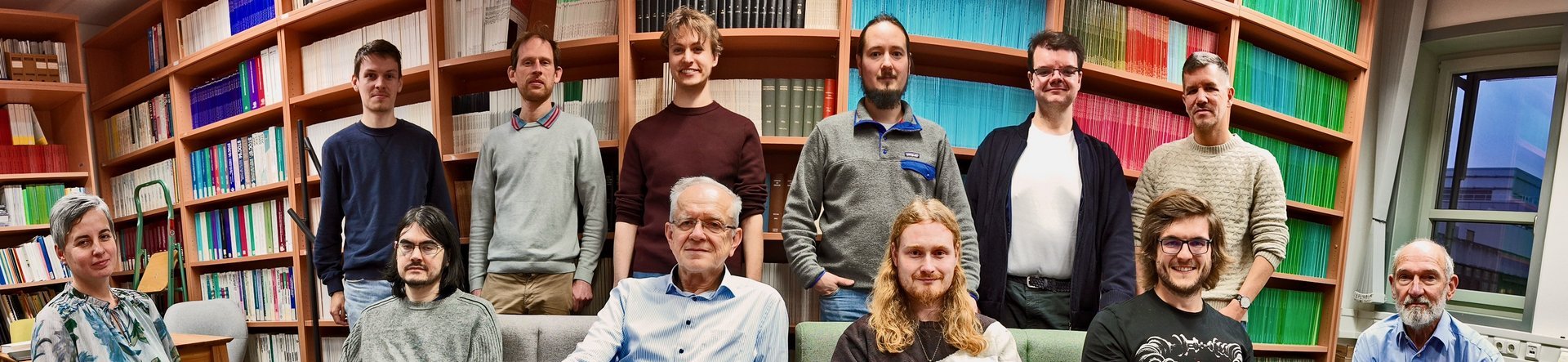
Prof. Dr. Rüdiger Reischuk
Prof. Dr. math. Rüdiger Reischuk
emeritus Institutsprofessor
| E-mail: | ruediger.reischuk@uni-luebeck.de |
| Adresse: | Institut für Theoretische Informatik Ratzeburger Allee 160 23562 Lübeck |
| Telefon: | +49 451 3101 5310 |
| Raum: | Raum 2083, Gebäude 64 |

Lebenslauf
| 1975 | geboren in Berlin |
| 1984 – 1990 | Jugendzeit in Windhuk, Namibia |
| 1994 | Abitur in Berlin |
| 1994 – 1999 | Studium an der TU Berlin |
| 1995 | Grundwehrdienst |
| 1999 | Diplom in Informatik an der TU Berlin |
| 1999 – 2005 | Wissenschaftlicher Mitarbeiter am Lehrstuhl Prof. Siefkes, TU Berlin |
| 2001 | Diplom in Mathematik an der TU Berlin |
| 2003 | Promotion zum Dr. rer.-nat. an der TU Berlin |
| 2004 | Einjähriger Forschungsaufenthalt bei Richard Karp am ICSI, Berkeley |
| 2005 | Ernennung zum Universitätsprofessor für Theoretische Informatik an der Universität zu Lübeck (W2) |
| 2007 | Verpartnerung mit Carsten Lenz |
| 2008 – 2025 | Studiendekan der Technisch-Naturwissenschaftlichen Fakultät, später der MINT-Sektionen |
| 2014 – 2020 | Vorsitzender des Wissenschaftlichen Beirats des Bundeswettbewerbs Informatik |
| 2015 | Ernennung zum W3-Professor an der Universität zu Lübeck |
| 2023 – heute | Vizepräsident der Universität zu Lübeck |
Positionen und Ämter
Preise und Stipendien
| 1993 | Silbermedaille bei der Internationalen Olympiade der Informatik in Mendoza, Argentinien |
| 1993 | Studienstipendium durch die Studienstiftung des Deutschen Volkes |
| 1994 | Dr. Habbena Preis für ein sehr gutes Abitur |
| 1999 | Erwin-Stephan-Preis der TU Berlin |
| 2002 | Best student paper award bei der MFCS 2002 |
| 2003 | Doktorarbeit wird für den GI-Dissertationspreis vorgeschlagen |
| 2007, 2010, 2014, 2018, 2021 | Lehrpreise der Studierenden der technisch-naturwissenschaftlichen Fakultät / der MINT-Sektionen (Heliprof 2007, Heliprof 2010, Heliprof 2014, Heliprof 2018, Heliprof 2021) |
2012
M.
Elberfeld
A.
Jakoby
T.
Tantau, 2012, S. 66-77. 12 S.
Algorithmic Meta Theorems for Circuit Classes of Constant and Logarithmic Depth , 29th International Symposium on Theoretical Aspects of Computer Science (STACS 2012)<br/>
Algorithmic Meta Theorems for Circuit Classes of Constant and Logarithmic Depth , 29th International Symposium on Theoretical Aspects of Computer Science (STACS 2012)<br/>
@inproceedings{e3a6d66ac26641d88970d0839861103c,title = "Algorithmic Meta Theorems for Circuit Classes of Constant and Logarithmic Depth",abstract = "An algorithmic meta theorem for a logic and a class C of structures states that all problems expressible in this logic can be solved efficiently for inputs from \$C\$. The prime example is Courcelle's Theorem, which states that monadic second-order (MSO) definable problems are linear-time solvable on graphs of bounded tree width. We contribute new algorithmic meta theorems, which state that MSO-definable problems are (a) solvable by uniform constant-depth circuit families (AC0 for decision problems and TC0 for counting problems) when restricted to input structures of bounded tree depth and (b) solvable by uniform logarithmic-depth circuit families (NC1 for decision problems and \#NC1 for counting problems) when a tree decomposition of bounded width in term representation is part of the input. Applications of our theorems include a TC0-completeness proof for the unary version of integer linear programming with a fixed number of equations and extensions of a recent result that counting the number of accepting paths of a visible pushdown automaton lies in \#NC1. Our main technical contributions are a new tree automata model for unordered, unranked, labeled trees; a method for representing the tree automata's computations algebraically using convolution circuits; and a lemma on computing balanced width-3 tree decompositions of trees in TC0, which encapsulates most of the technical difficulties surrounding earlier results connecting tree automata and NC1.",author = "Michael Elberfeld and Andreas Jakoby and Till Tantau",year = "2012",month = jan,doi = "10.4230/LIPIcs.STACS.2012.66",language = "English",isbn = "978-3-939897-35-4",volume = "14",series = "Leibniz International Proceedings in Informatics (LIPIcs)",publisher = "Schloss Dagstuhl--Leibniz-Zentrum fuer Informatik",pages = "66--77",editor = "Christoph D{\"u}rr and Thomas Wilke",booktitle = "29th International Symposium on Theoretical Aspects of Computer Science (STACS 2012)",note = "29th International Symposium on Theoretical Aspects of Computer Science (STACS 2012)<br/> ; Conference date: 29-02-2012 Through 03-03-2012",url = "http://www.wikicfp.com/cfp/servlet/event.showcfp?eventid=16636..",}
M.
Elberfeld
I.
Schnoor
T.
Tantau, 2012, S. 38-51. 14 S.
Influence of tree topology restrictions on the complexity of haplotyping with missing data
Influence of tree topology restrictions on the complexity of haplotyping with missing data
@article{39584e3a59b44ad7b7997362cd18d25a,title = "Influence of tree topology restrictions on the complexity of haplotyping with missing data",abstract = "Haplotyping, also known as haplotype phase prediction, is the problem of predicting likely haplotypes based on genotype data. One fast haplotyping method is based on an evolutionary model in which a perfect phylogenetic tree is sought that explains the observed data. Unfortunately, when data entries are missing, which is often the case in laboratory data, the resulting formal problem ipph, which stands for incomplete perfect phylogeny haplotyping, is NP-complete. Even radically simplified versions, such as the restriction to phylogenetic trees consisting of just two directed paths from a given root, are still NP-complete; but here, at least, a fixed-parameter algorithm is known. Such drastic and ad hoc simplifications turn out to be unnecessary to make ipph tractable: we present the first theoretical analysis of a parameterized algorithm, which we develop in the course of the paper, that works for arbitrary instances of ipph. This tractability result is optimal insofar as we prove ipph to be NP-complete whenever any of the parameters we consider is not fixed, but part of the input.",author = "Michael Elberfeld and Ilka Schnoor and Till Tantau",year = "2012",month = may,day = "11",doi = "10.1016/j.tcs.2012.01.015",language = "English",volume = "432",pages = "38--51",journal = "Theoretical Computer Science",issn = "0304-3975",publisher = "Elsevier B.V.",}
M.
Elberfeld
C.
Stockhusen
T.
Tantau, 2012, S. 206-217. 12 S.
On the Space Complexity of Parameterized Problems , 7th International Symposium, IPEC 2012
On the Space Complexity of Parameterized Problems , 7th International Symposium, IPEC 2012
@inproceedings{d7b51e6a9db14bfc91973c41176d2b30,title = "On the Space Complexity of Parameterized Problems",abstract = "Parameterized complexity theory measures the complexity of computational problems predominantly in terms of their parameterized time complexity. The purpose of the present paper is to demonstrate that the study of parameterized space complexity can give new insights into the complexity of well-studied parameterized problems like the feedback vertex set problem. We show that the undirected and the directed feedback vertex set problems have different parameterized space complexities, unless L = NL; which explains why the two problem variants seem to necessitate different algorithmic approaches even though their parameterized time complexity is the same. For a number of further natural parameterized problems, including the longest common subsequence problem and the acceptance problem for multi-head automata, we show that they lie in or are complete for different parameterized space classes; which explains why previous attempts at proving completeness of these problems for parameterized time classes have failed.",author = "Michael Elberfeld and Christoph Stockhusen and Till Tantau",year = "2012",month = sep,doi = "10.1007/978-3-642-33293-7\_20",language = "English",isbn = "978-3-642-33292-0",volume = "7535",series = "Lecture Notes in Computer Science",publisher = "Springer Berlin Heidelberg",pages = "206--217",editor = "Thilikos, \{Dimitrios M.\} and Woeginger, \{Gerhard J.\}",booktitle = "Parameterized and Exact Computation",note = "7th International Symposium, IPEC 2012 ; Conference date: 12-09-2012 Through 14-09-2012",}
M.
Elberfeld
T.
Tantau, 2012, S. 33-47. 15 S.
Phylogeny- and parsimony-based haplotype inference with constraints
Phylogeny- and parsimony-based haplotype inference with constraints
@article{aa5c1b38d1c0481a8343590bf7716ed2,title = "Phylogeny- and parsimony-based haplotype inference with constraints",abstract = "Haplotyping, also known as haplotype phase prediction, is the problem of predicting likely haplotypes based on genotype data. One fast computational haplotyping method is based on an evolutionary model where a perfect phylogenetic tree is sought that explains the observed data. An extension of this approach tries to incorporate prior knowledge in the form of a set of candidate haplotypes from which the right haplotypes must be chosen. The objective is to increase the accuracy of haplotyping methods, but it was conjectured that the resulting formal problem constrained perfect phylogeny haplotyping might be NP-complete. In the paper at hand we present a polynomial-time algorithm for it. Our algorithmic ideas also yield new fixed-parameter algorithms for related haplotyping problems based on the maximum parsimony assumption.",author = "Michael Elberfeld and Till Tantau",year = "2012",month = apr,day = "1",doi = "10.1016/j.ic.2011.03.009",language = "English",volume = "213",pages = "33--47",journal = "Information and Computation",issn = "0890-5401",publisher = "Elsevier Inc.",}
V.
Damerow
B.
Manthey
F.
Heide
H.
Racke
C.
Scheideler
C.
Sohler
T.
Tantau, 2012
Smoothed analysis of left-to-right maxima with applications
Smoothed analysis of left-to-right maxima with applications
@article{748c180177624066a96acc6ac2d9edd8,title = "Smoothed analysis of left-to-right maxima with applications",abstract = "A left-to-right maximum in a sequence of n numbers s1, sn is a number that is strictly larger than all preceding numbers. In this article we present a smoothed analysis of the number of left-to-right maxima in the presence of additive random noise. We show that for every sequence of nnumbers si ε [0, 1] that are perturbed by uniform noise from the interval [-ε, ε], the expected number of left-to-right maxima is Θ (Mathematical Equation Presented) for ε > 1/n. For Gaussian noise with standard deviation σ we obtain a bound of O((log 3/2 n)/σ + log n). We apply our results to the analysis of the smoothed height of binary search trees and the smoothed number of comparisons in the quicksort algorithm and prove bounds of Θ (Mathematical Equation Presented), respectively, for uniform random noise from the interval [-ε, ε]. Our results can also be applied to bound the smoothed number of points on a convex hull of points in the two-dimensional plane and to smoothed motion complexity, a concept we describe in this article. We bound how often one needs to update a data structure storing the smallest axis-aligned box enclosing a set of points moving in d-dimensional space.",author = "Valentina Damerow and Bodo Manthey and Heide, \{Friedhelm Meyer Auf Der\} and Harald Racke and Christian Scheideler and Christian Sohler and Till Tantau",year = "2012",month = jul,day = "1",doi = "10.1145/2229163.2229174",language = "English",volume = "8",journal = "ACM Transactions on Algorithms",issn = "1549-6325",publisher = "Association for Computing Machinery ",number = "3",}
M.
Elberfeld
M.
Grohe
T.
Tantau, 2012, S. 265-274. 10 S.
Where First-Order and Monadic Second-Order Logic Coincide , 2012 27th Annual IEEE Symposium on Logic in Computer Science
Where First-Order and Monadic Second-Order Logic Coincide , 2012 27th Annual IEEE Symposium on Logic in Computer Science
@conference{755635f6bf2840659cd9645c3d7fcfcc,title = "Where First-Order and Monadic Second-Order Logic Coincide",abstract = "We study on which classes of graphs first-order logic (FO) and monadic second-order logic (MSO) have the same expressive power. We show that for each class of graphs that is closed under taking subgraphs, FO and MSO have the same expressive power on the class if, and only if, it has bounded tree depth. Tree depth is a graph invariant that measures the similarity of a graph to a star in a similar way that tree width measures the similarity of a graph to a tree. For classes just closed under taking induced subgraphs, we show an analogous result for guarded second-order logic (GSO), the variant of MSO that not only allows quantification over vertex sets but also over edge sets. A key tool in our proof is a Feferman-Vaught-type theorem that is constructive and still works for unbounded partitions.",author = "Michael Elberfeld and Martin Grohe and Till Tantau",year = "2012",month = aug,day = "23",doi = "10.1109/LICS.2012.37",language = "English",pages = "265--274",note = "2012 27th Annual IEEE Symposium on Logic in Computer Science ; Conference date: 25-06-2012 Through 28-06-2012",}
2010
M.
Elberfeld
A.
Jakoby
T.
Tantau, 2010, S. 143-152. 10 S.
Logspace Versions of the Theorems of Bodlaender and Courcelle , 2010 IEEE 51st Annual Symposium on Foundations of Computer Science
Logspace Versions of the Theorems of Bodlaender and Courcelle , 2010 IEEE 51st Annual Symposium on Foundations of Computer Science
@inproceedings{0c166bb8de96483b91b23ded35ff6ed9,title = "Logspace Versions of the Theorems of Bodlaender and Courcelle",abstract = "Bodlaender's Theorem states that for every k there is a linear-time algorithm that decides whether an input graph has tree width k and, if so, computes a width-k tree composition. Courcelle's Theorem builds on Bodlaender's Theorem and states that for every monadic second-order formula φ and for every k there is a linear-time algorithm that decides whether a given logical structure A of tree width at most k satisfies φ. We prove that both theorems still hold when {"}linear time{"} is replaced by {"}logarithmic space.{"} The transfer of the powerful theoretical framework of monadic second-order logic and bounded tree width to logarithmic space allows us to settle a number of both old and recent open problems in the log space world.",author = "M. Elberfeld and A. Jakoby and T. Tantau",year = "2010",month = dec,day = "17",doi = "10.1109/FOCS.2010.21",language = "English",isbn = "978-1-4244-8525-3",series = "Annual Symposium on Foundations of Computer Science",publisher = "IEEE",pages = "143--152",booktitle = "2010 IEEE 51st Annual Symposium on Foundations of Computer Science",note = "2010 IEEE 51st Annual Symposium on Foundations of Computer Science ; Conference date: 23-10-2010 Through 26-10-2010",}
E.
Hemaspaandra
L.
Hemaspaandra
T.
Tantau
O.
Watanabe, 2010, S. 783-798. 16 S.
On the complexity of kings
On the complexity of kings
@article{a8558303021b4dacb49b29b830df6ef5,title = "On the complexity of kings",abstract = "A king in a directed graph is a vertex from which each vertex in the graph can be reached through paths of length at most two. There is a broad literature on tournaments (completely oriented digraphs), and it has been known for more than half a century that all tournaments have at least one king. Recently, kings have proven useful in theoretical computer science, in particular in the study of the complexity of reachability problems and semifeasible sets. In this article, we study the complexity of recognizing kings. For each succinctly specified family of tournaments, the king problem is already known to belong to Π2p. We prove that the complexity of kingship problems is a rich enough vocabulary to pinpoint every nontrivial many-one degree in Π2p. That is, we show that every set in Π2p other than 0\{combining long solidus overlay\} and Σ* is equivalent to a king problem under ≤mp-reductions. Indeed, we show that the equivalence can even be realized by relatively simple padding, and holds even if the notion of kings is redefined to refer to k-kings (for any fixed k ≥ 2)-vertices from which all vertices can be reached through paths of length at most k. In contrast, we prove that for each succinctly specified family of tournaments the source problem (the problem of deciding whether a given vertex v has the property that there exists a k such that v is a k-king) also falls within Π2p, yet cannot be Π2p-complete-or even NP-hard-unless P = NP. Using these and related techniques, we obtain a broad range of additional results about the complexity of king problems, diameter problems, and radius problems. It follows easily from our proof approach that the problem of testing kingship in succinctly specified graphs (which need not be tournaments) is Π2p-complete. We show that the radius problem for arbitrary succinctly represented graphs is Σ3p-complete, but that in contrast the diameter problem for arbitrary succinctly represented graphs (or even tournaments) is Π2p-complete.",author = "Edith Hemaspaandra and Hemaspaandra, \{Lane A.\} and Till Tantau and Osamu Watanabe",year = "2010",month = jan,day = "28",doi = "10.1016/j.tcs.2009.10.015",language = "English",volume = "411",pages = "783--798",journal = "Theoretical Computer Science",issn = "0304-3975",publisher = "Elsevier B.V.",number = "4-5",}
M.
Elberfeld
T.
Tantau, 2010, S. 177-189. 13 S.
Phylogeny- and Parsimony-Based Haplotype Inference with Constraints , 21st Annual Symposium, CPM 2010
Phylogeny- and Parsimony-Based Haplotype Inference with Constraints , 21st Annual Symposium, CPM 2010
@inproceedings{f90ef28d108741a48fd4fa8f3f7977fd,title = "Phylogeny- and Parsimony-Based Haplotype Inference with Constraints",abstract = "Haplotyping, also known as haplotype phase prediction, is the problem of predicting likely haplotypes based on genotype data. One fast computational haplotyping method is based on an evolutionary model where a perfect phylogenetic tree is sought that explains the observed data. In their cpm 2009 paper, Fellows et al. studied an extension of this approach that incorporates prior knowledge in the form of a set of candidate haplotypes from which the right haplotypes must be chosen. While this approach may help to increase the accuracy of haplotyping methods, it was conjectured that the resulting formal problem constrained perfect phylogeny haplotyping might be NP-complete. In the present paper we present a polynomial-time algorithm for it. Our algorithmic ideas also yield new fixed-parameter algorithms for related haplotyping problems based on the maximum parsimony assumption.",author = "Michael Elberfeld and Till Tantau",year = "2010",month = jun,doi = "10.1007/978-3-642-13509-5\_17",language = "English",isbn = "978-3-642-13508-8",volume = "6129",series = "Lecture Notes in Computer Science",publisher = "Springer Berlin Heidelberg",pages = "177--189",editor = "Amihood Amir and Laxmi Parida",booktitle = "Combinatorial Pattern Matching",note = "21st Annual Symposium, CPM 2010 ; Conference date: 21-06-2010 Through 23-06-2010",}
2009
M.
Elberfeld
I.
Schnoor
T.
Tantau, 2009, S. 201-210
Influence of Tree Topology Restrictions on the Complexity of Haplotyping with Missing Data
Influence of Tree Topology Restrictions on the Complexity of Haplotyping with Missing Data
@inproceedings{d8d02a8dad7147a1a34ec6dbf5e1b032,title = "Influence of Tree Topology Restrictions on the Complexity of Haplotyping with Missing Data",abstract = "Haplotyping, also known as haplotype phase prediction, is the problem of predicting likely haplotypes from genotype data. One fast haplotyping method is based on an evolutionary model where a perfect phylogenetic tree is sought that explains the observed data. Unfortunately, when data entries are missing as is often the case in laboratory data, the resulting incomplete perfect phylogeny haplotyping problem ipph is NP-complete and no theoretical results are known concerning its approximability, fixed-parameter tractability, or exact algorithms for it. Even radically simplified versions, such as the restriction to phylogenetic trees consisting of just two directed paths from a given root, are still NP-complete; but here a fixed-parameter algorithm is known. We show that such drastic and ad hoc simplifications are not necessary to make ipph fixed-parameter tractable: We present the first theoretical analysis of an algorithm, which we develop in the course of the paper, that works for arbitrary instances of ipph. On the negative side we show that restricting the topology of perfect phylogenies does not always reduce the computational complexity: while the incomplete directed perfect phylogeny problem is well-known to be solvable in polynomial time, we show that the same problem restricted to path topologies is NP-complete.",author = "Michael Elberfeld and Ilka Schnoor and Till Tantau",year = "2009",language = "English",series = "Lecture Notes in Computer Science",publisher = "Springer Verlag",pages = "201--210",booktitle = "roceedings of the 6th Annual Conference on Theory and Applications of Models of Computation (TAMC 2009)",}
Weitere Links: